

Resources for your personal introspection that
can help you with personal growth.
Resources to overcome your roadblocks
Body Idioms
I don’t experience idioms as simple expressions. I see them as subtle linguistic markers—small windows into the body’s history. The phrases someone reaches for can reveal traces of what their body has carried, endured, or adapted to over time. In medical terminology, the term idiopathic describes a condition with an unknown cause. Interestingly, idioms can behave similarly: they often emerge without a clear origin, carrying meanings that are figurative rather than literal. In that sense, idioms themselves can be “idiopathic”—mysterious, inherited through culture, and shaped by lived experience. For me, this makes idioms powerful clues, offering insight into the physical or emotional patterns a person has moved through.
Below is a growing breakdown of idioms connected to the body as a whole. This list is something I’m building for my own reference, but you’re welcome to explore it as it evolves. Some of the categories will also include a YouTube link at the end—simple practices or guided movements that can help release some of the tension, holding, or emotional residue reflected in these idioms.
The material is organized into three sections to reflect the different ways idioms map onto the body’s regions, organs, and underlying systems.
Idioms by Body Region (Function, Emotion, Symbolism)
Head & Mind: Head, Face, and Neck Lymphatic Massage
Face & Expression: Suppressed Face & Voice-1:20 / Qigong Face Massage
Throat, Voice & Neck: Neck Trauma
Heart & Chest: Qigong Heart Health-0:19 / 15 min Heart Health
Gut & Core: 10 min STANDING ABS Workout
Hands & Arms: Hand Self Massage/ Hand and Finger Yoga/Qigong for Hands
Neck: Qigong Neck & Shoulders Yoga/ Neck and Shoulders Stretching / TAIJI DRAGON FLOW | NECK AND SHOULDER MOBILITY
Back & Spine: Standing Lower Back Stretches - for office or home
Butt & Rear: Fascia Hopping
Legs & Feet: 10 Min Leg Strength
🧠 Head & Mind
“In over my head” — overwhelmed beyond capacity.
“Losing my head” — acting without clarity.
“Keeping a level head” — staying calm and steady.
“A head start” — beginning with an advantage.
“Banging my head against a wall” — repeated effort with no progress.
“A lot on my mind” — mental load affecting the whole system.
“Mind blown” — overwhelmed by new information.
“Out of my mind” — extreme stress or emotional overload.
“A clear head” — mental clarity and ease.
_____________________________________________________________________________________________________________________________________Simple Lymphatic Massage for the Head, Face, and Neck
_____________________________________________________________________________________________________________________________________
😶 Face & Expression
“Saving face” — protecting dignity or identity.
“Face the music” — confronting consequences.
“Two‑faced” — presenting conflicting identities.
“A poker face” — concealing emotion.
“Written all over your face” — emotions showing through the body.
“Face to face” — direct, embodied interaction.
“Lose face” — feeling diminished or exposed.
_____________________________________________________________________________________________________________________________________Suppressed Emotions are Blocking Your Voice | Here's How to Release Them
QIGONG ANTI-AGING FACE MASSAGE
_____________________________________________________________________________________________________________________________________
🗣️ Throat, Voice & Neck
“Finding my voice” — reclaiming agency or expression.
“A lump in my throat” — emotion rising into the body.
“Choking up” — overwhelmed by feeling.
“Speaking from the heart” — authentic expression.
“Bite my tongue” — holding back truth or reaction.
“A pain in the neck” — persistent irritation or strain.
_____________________________________________________________________________________________________________________________________Release neck trauma: Somatic Exercises to Release Stored Trauma From The Neck | 10 Minutes
_____________________________________________________________________________________________________________________________________
❤️ Heart & Chest (Emotion, Courage, Vulnerability)
“Heart on my sleeve” — visible vulnerability.
“Heavy‑hearted” — emotional weight.
“Heartbroken” — deep emotional rupture.
“Take it to heart” — internalizing impact.
“A change of heart” — a shift in direction or feeling.
“Heart of gold” — generosity or warmth.
“My heart skipped a beat” — sudden emotional jolt.
“My heart isn’t in it”
“Heart of stone”
_____________________________________________________________________________________________________________________________________
QIGONG for HEART HEALTH | 10 Minute Daily Routines
_____________________________________________________________________________________________________________________________________
🧭 Gut & Core
“Gut feeling” — intuitive knowing.
“Gut punch” — shock felt through the whole body.
“Butterflies in my stomach” — activation or anticipation.
“Stomach turning” — deep discomfort.
“No backbone, no guts” — lack of courage or stability.
“Fire in my belly” — drive or determination.
_____________________________________________________________________________________________________________________________________
10 min STANDING ABS Workout
_____________________________________________________________________________________________________________________________________
✋ Hands & Arms
“Hands full” — overwhelmed or at capacity.
“Wash my hands of it” — releasing responsibility.
“In good hands” — safe or supported.
“Hands tied” — restricted or unable to act.
“Lend a hand” — offering support.
“Strong‑armed” — pressured or coerced.
“Caught red‑handed” — caught in the act.
_____________________________________________________________________________________________________________________________________
Hand Self Massage for Hand Pain Relief
Hand and Finger Exercises | Hand Yoga
Qigong for Hands: Easy Self-Care to Heal and Revitalize Your Hands
_____________________________________________________________________________________________________________________________________
🧖♂️ Neck
“A pain in the neck” — persistent irritation; something that tightens the upper spine and draws attention.
“Breathe down your neck” — pressure, surveillance, or someone encroaching on your personal space.
“Hang something around your neck” — being burdened with responsibility, guilt, or obligation.
“Risk your neck” — taking a dangerous or vulnerable action; exposing a vital hinge point.
“Stick your neck out” — taking a risk or speaking up; extending yourself beyond safety.
“Up to your neck in” — overwhelmed or overloaded; submerged in responsibilities or problems.
_____________________________________________________________________________________________________________________________________
10 MINUTES | SEATED QIGONG | NECK AND SHOULDER
_____________________________________________________________________________________________________________________________________
💪 Shoulders
“Carrying the weight of the world” — heavy responsibility.
“A weight off my shoulders” — release and relief.
“Shouldering the burden” — taking on responsibility.
“Cold shoulder” — withdrawing connection.
“Chip on my shoulder” — carrying old resentment or defensiveness.
____________________________________________________________________________________________________________________________________
Exercise for Shoulders | Body & Brain Yoga Exercises
Stretching for the Neck and Shoulders | Body & Brain Yoga
_____________________________________________________________________________________________________________________________________
🧍♂️ Back & Spine
“Backbone” — inner strength or integrity.
“Stabbed in the back” — betrayal felt deeply.
“Get off my back” — pressure or intrusion.
“Put my back into it” — full‑body effort.
“Turn my back on” — withdrawing support or presence.
“Backed into a corner” — no room to move or choose.
_____________________________________________________________________________________________________________________________________
Standing Lower Back Stretches - for office or home
_____________________________________________________________________________________________________________________________________
🍑 Butt / Rear Idioms
A kick in the butt — A jolt of motivation; an external force pushing you into motion.
A pain in the butt — Persistent irritation; something that nags at your attention.
Bite you in the butt — Consequences circling back; what was avoided returns from behind.
Busted my butt — Working intensely; exerting full physical effort
Cover your butt — Protecting yourself from blame; guarding the vulnerable backside.
Chew someone’s butt out — Receiving harsh criticism, pressure is applied from behind.
Get off your butt — Moving from inertia to action; shifting from stillness to engagement.
Get your butt in gear — Mobilizing energy; activating the body’s propulsion system.
Kick butt — Showing strength or excellence; powerful forward momentum.
Kick someone’s butt — Overpowering or outperforming; dominance expressed through force.
Laugh your butt off — Release through humor; tension leaving the body.
Move your butt — Urgency: activating the lower body to respond.
Put your butt on the line — Taking a risk; exposing a vulnerable part of yourself.
Save your butt — Avoiding danger or consequences; protecting the self.
Sit on your butt — Inaction: staying in a passive or waiting state.
Tear someone a new one(colloquial, but common) — Intense reprimand; overwhelming pressure directed at the back body.
_____________________________________________________________________________________________________________________________________
Fasia Hopping
_____________________________________________________________________________________________________________________________________
🦵 Legs & Feet
“Finding my footing” — gaining stability.
“Knocked off my feet” — overwhelmed by impact.
“Stand my ground” — holding boundaries.
“On my last legs” — near exhaustion.
“Put my best foot forward” — showing up with intention.
“Get cold feet” — fear stops movement.
“Walk all over me” — boundaries being crossed.
_____________________________________________________________________________________________________________________________________Boost Your LEG Strength with 10 Minute Tai Chi Fitness Routine
_____________________________________________________________________________________________________________________________________
Body's Organ Idioms
Organs carry their own emotional and symbolic signatures, and our language reflects that. Long before we understood anatomy in a scientific way, people used the heart, gut, lungs, liver, and other organs as metaphors for feeling, intuition, courage, fear, and resilience. These expressions reveal how deeply we sense the body’s inner landscape, even without naming it directly. Idioms tied to organs often mirror the roles those organs play—hearts feel, guts know, lungs release, skin protects, blood remembers. When someone uses these phrases, they’re often pointing to patterns their body has lived through, whether consciously or not.
This section gathers idioms connected to the body’s major organs. It’s an evolving reference for exploring how language and physiology intertwine, and how the body’s deeper stories show up in the words we choose.
As we move from organs to the systems that bind, support, and nourish the body, this next section explores how flow and structure show up in our language. You’ll also find a YouTube link at the end for some of the list, offering a small practice to help soften or release what these idioms point toward.
The material is organized into three sections to reflect the different ways idioms map onto the body’s regions, organs, and underlying systems.
Idioms Connected to Organs (Function, Emotion, Symbolism)
Brain: Brain Tapping for Info Overload-0:31
Eye: Qigong for Eyes
Gut: Qi Gong for Gut Health- 0:51/Constipation Relief
Heart:10-Minute Low-Impact Cardio Routine / OPENING THE HEART
Kidneys: Qi Gong for Kidney Health
Liver: Boost Your Liver Health Qi Gong Detox Flow!
Lungs: 10 Min Lung Meridian-1:06
Pancreas: TCM Acupressure and Qi Gong-18:43
Skin: 8 Minute Morning Face Yoga
Spleen: Qigong for Spleen Health: Boost Your Digestion and Energy
🧠 Brain (Thinking, Memory, Perception)
“Brainchild” — an idea formed through internal synthesis and cognitive creation.
“Brain freeze” — a sudden halt in mental flow; a momentary shock to the system.
“Brainstorm” — the mind generating rapid neural activity; ideas firing and connecting.
“Mind over matter” — cognitive regulation overriding physical or emotional impulses.
“Pick your brain” — drawing from someone’s stored knowledge or cognitive pathways.
“Rack my brain” — stretching mental circuits to retrieve or process information.
“Scatterbrained” — thoughts dispersed across multiple neural pathways; difficulty integrating.
_____________________________________________________________________________________________________________________________________
Dealing with Information Overload | Body & Brain Tapping and Stretching
_____________________________________________________________________________________________________________________________________
👁️Eye (Perception, Intuition, Vigilance, Vulnerability, and the ways we let the world in.)
“All eyes on you” — Focused attention converges on one point; the body feels “seen” or exposed.
“An eye for an eye” — A mirrored response; matching what was taken or felt.
____________________________________________________________________________________________________________________________________
Qigong for Eyes: Relieve Eye Fatigue & Boost Vision Naturally
____________________________________________________________________________________________________________________________________
🧠 Gut (Intuition, Instinct, Emotional Processing)
“Butterflies in my stomach” — activation or anticipation.
“Fire in my belly” — drive or determination.
“Gut feeling” — intuitive knowing.
“Gut punch” — shock felt through the whole body.
“No backbone, no guts” — lack of courage or stability.
“No guts, no glory” — the core as a site of bravery, activation, and inner resolve.
“Stomach turning” — deep discomfort.
_____________________________________________________________________________________________________________________________________
QIGONG | 10-MINUTE ROUTINE FOR DIGESTIVE HEALTH | GUT HEALTH
Constipation Relief | Body & Brain Routines
_____________________________________________________________________________________________________________________________________
🧠 Heart + Gut + Brain (Integrated Idioms)
“Follow your heart” — moving in alignment with emotional rhythm; the heart as a compass of feeling and desire.
“My head says one thing, my heart says another” — cognitive pathways and emotional centers offering different forms of guidance.
“Trust your gut” — sensing through the enteric system; intuition arising from deep visceral intelligence.
“Use your head” — drawing on mental clarity, reasoning, and cortical processing to navigate a situation.
_____________________________________________________________________________________________________________________________________
10-Minute Low-Impact Cardio Routine_____________________________________________________________________________________________________________________________________
🩺 Kidneys (Filtering, Strength, Vitality)
“Of strong kidneys” — old idiom meaning brave or resilient.
“Guts and kidneys” — old phrase meaning inner fortitude.
“Weak‑kneed” — lacking inner strength. (adjacent to kidney symbolism)
_____________________________________________________________________________________________________________________________________Qi Gong for Kidney Health: Boost Energy and Restore Vitality
_____________________________________________________________________________________________________________________________________
🫁 Lungs (Breath, Capacity, Relief)
“A breath of fresh air” — an influx of new oxygen; renewal entering the system.
“Breathe easy” — the respiratory system settling; tension releasing through exhalation.
“Catch my breath” — the body pauses to regulate rhythm and restore balance.
“Running out of breath” — diminished respiratory capacity; energy reserves thinning.
“Take my breath away” — a sudden surge of sensation that interrupts normal breathing patterns.
_____________________________________________________________________________________________________________________________________
LUNG MERIDIAN Exercises for Chest Pain | 10 Minute Daily Routines
_____________________________________________________________________________________________________________________________________
🟡 Pancreas (Sweetness, Bitterness, Regulation, Hidden Work)
Idioms Connected to “Sweetness” (Insulin / Sugar Themes)
“Not all sweetness and light” — something that appears pleasant but isn’t.
“A spoonful of sugar helps the medicine go down” — softening something difficult.
“Sugarcoat it” — making something harsh easier to take.
“Sweeten the deal” — adding incentive or comfort.
“Too sweet to be wholesome” — something that feels “off” beneath the surface
Idioms Connected to “Bitterness” (Opposite of Sweetness)
“A bitter pill to swallow” — difficult truth or experience.
“Bittersweet” — mixed emotional experience.
“Bitter to the core” — deep emotional resentment.
“Leave a bitter taste” — lingering emotional discomfort.
Idioms Connected to “Regulation & Balance” (Pancreatic Function)
“A balancing act” — managing competing demands.
“Keeping things in check” — maintaining internal balance.
“Running hot and cold” — fluctuating states.
“Thrown off balance” — dysregulation or instability.
“Too much of a good thing” — excess becomes harmful.
Idioms Connected to “Hidden Work” (Pancreas as a Behind‑the‑Scenes Organ)
“Behind the scenes” — unseen processes that make things work.
“Doing the heavy lifting quietly” — invisible labor.
“Running under the radar” — unnoticed but active.
“The unsung hero” — vital but unnoticed effort.
“Working in the background” — quiet, essential support.
Idioms Connected to “Energy & Fuel” (Glucose Metabolism)
“A burst of energy” — sudden activation.
“Fueling the fire” — adding intensity.
“Running on empty” — exhaustion.
“Running on pure adrenaline” — energy bypassing normal regulation.
“Running out of steam” — depleted energy.
_____________________________________________________________________________________________________________________________________Spleen Health REVOLUTION with TCM Acupressure and Qi Gong!
_____________________________________________________________________________________________________________________________________
🫀 Skin (Boundaries, Sensitivity, Identity)
“By the skin of my teeth” — surviving with minimal margin; the body’s outer boundary narrowly holding.
“Get under my skin” — an external stimulus penetrating emotional or sensory boundaries.
“Jump out of my skin” — a sudden surge in the startle response; the nervous system jolting into hyper‑arousal.
“Skin in the game” — personal investment that activates protective and sensory awareness.
“Thick‑skinned” — a buffered emotional boundary; reduced sensitivity to external impact.
“Thin‑skinned” — heightened sensitivity; the boundary layer is easily affected or irritated._____________________________________________________________________________________________________________________________________
8 Minute Morning Face Yoga To Do Each Morning l Get Glowing Skin All Day l Strengthen Face Muscle 💕💕
_____________________________________________________________________________________________________________________________________
🫁 Spleen (Anger, Release)
(The spleen historically symbolized anger.)
“Spleenful” — irritable or spiteful (older usage)
“Vent your spleen” — release anger
_____________________________________________________________________________________________________________________________________
Qigong for Spleen Health: Boost Your Digestion and Energy
_____________________________________________________________________________________________________________________________________
Body Systems of Flow, Support, and Integration
Beyond individual organs and distinct body regions, there are deeper systems that hold everything together. These networks shape how we move, stabilize, circulate, and connect. Fascia weaves the body into a continuous web. Joints negotiate direction and possibility. Muscles generate force and expression. Bones and ligaments offer structure and support. Blood and lymph carry nourishment, immunity, and renewal. Breath animates the entire system with rhythm and presence.
Idioms that reference these systems often reveal how we experience flow, tension, grounding, resilience, or overwhelm in our lives. They point to the ways the body organizes itself beneath conscious awareness. As with the other sections, some of the list here will end with a YouTube link offering a simple practice to help release or soften the patterns reflected in these expressions.
The material is organized into three sections to reflect the different ways idioms map onto the body’s regions, organs, and underlying systems.
Idioms for Systems Networks (Function, Emotion, Symbolism)
The Body’s Webs
Fascia (web of tissue): 10 min Fascia Exercise-1:22
Nerves (web of communication): QIGONG | DAILY ENERGIZING ROUTINE
Circulation & Flow Systems
Blood: THREE MOVEMENTS FOR BETTER CIRCULATION / GET YOUR QI FLOWING | QIGONG
Breath: Qigong Breathing Flow -1:48 / Pranayama 10 mins to release stress / Psychedelic Fast Tempo Breathwork
Energy: 15 min Qigong / SIMPLE TAOIST Taichi Moves to REVITALIZE Your Vital Organs
Lymph: Lymphatic Massage for the Head, Face, and Neck / QIGONG FOR LYMPHATIC FLOW | SWING ARM QIGONG
Movement & Mobility Systems:
Joints: Joint Tai Chi warm-up-0:21 / Whole-Body Joint Mobility Exercises
Muscles: Mate - Docu - EN- 16-9 - Ads 03.mp4
Structural Systems
Bones: Bone Marrow Cleansing Qi Gong ☯ Xi sui jing / Bone Strength
Ligaments: SHAKE AWAY MERIDIAN BLOCKAGES / QIGONG
The Body’s Webs: Fascia (web of tissue) / Nerves (web of communication)
🕸️ Fascia (Connection, Tension, Binding, Integration)Connects everything — it’s the body’s continuous web.
Idioms That Reflect Fascia’s Themes of Connection
“Holding it all together” — maintaining cohesion under stress.
“Everything is connected” — recognizing interdependence.
“Tied together” — linked elements forming a whole.
“Hanging by a thread” — fragile structural integrity.
“Cut from the same cloth” — shared origin or pattern.
Idioms That Mirror Tension, Tightness, or Restriction
“Wound tight” — high tension throughout the system.
“Tied up in knots” — emotional or physical constriction.
“Stretched thin” — overextension leading to strain.
“Pulled in every direction” — multidirectional tension.
“Under pressure” — compression affecting the whole system
Idioms That Echo Glide, Movement, and Release
“Go with the flow” — ease of movement and adaptability.
“Loosen up” — releasing tension.
“Let it slide” — allowing movement without resistance.
“Smooth things over” — restoring glide and harmony.
“Ease into it” — gradual softening or opening.
Idioms That Reflect Binding, Webs, and Hidden Layers
“Behind the scenes” — unseen structures doing essential work.
“Under the surface” — deeper layers influencing experience.
“A tangled web” — complex interwoven dynamics.
“Caught in the web” — stuck in interconnected patterns.
“Layers upon layers” — complexity within the system.
_____________________________________________________________________________________________________________________________________
_____________________________________________________________________________________________________________________________________
⚡ Nerves — Anatomical‑Symbolic (Alphabetical List)
“Get on my nerves” — irritation activates the system’s sensitive pathways; overstimulation of neural circuits.
“Nerve‑wracking” — tension stretching the system’s wiring; heightened alertness pushing the limits of tolerance.
“On edge” — the nervous system primed and vigilant; signals firing rapidly in anticipation.
“Rattle my nerves” — sudden disruption shaking the system’s stability; a jolt through delicate neural channels.
“Steady your nerves” — calming the system’s electrical activity; restoring regulated, grounded signaling.
“Touch a nerve” — striking a sensitive point; activating a pathway tied to memory, emotion, or vulnerability.
____________________________________________________________________________________________________________________________________
Understanding Numbness Through the Nervous System | Somatic Exercises
_____________________________________________________________________________________________________________________________________
Circulation & Flow Systems: Blood / Breath / Lymph
🩸 Blood (Family, Passion, Life Force)The medium of flow, nourishment, and circulation.
“Bad blood” — relational tension carried like a lingering inflammatory response.
“Blood, sweat, and tears” — full‑body exertion; effort drawn from circulatory, muscular, and emotional reserves.
“Blood is thicker than water” — the circulatory bond as a symbol of deep loyalty; relational ties felt as an enduring internal connection.
“Cold‑blooded” — emotional detachment; reduced affective warmth in the system.
“In my blood” — a trait or tendency felt as inherited, embodied, or deeply ingrained.
“Make my blood boil” — a surge of internal heat; sympathetic activation rising through the system.
__________________________________________________________________________________________________________________________________MAKE Body WARM, Blood FLOWING GOOD | 5-Minute Qigong Activate Hands and Legs
_____________________________________________________________________________________________________________________________________
💨 Breath (Life, Presence, Relief, Overwhelm)
Idioms About Presence & Life Force
“A breath of fresh air” — an influx of new oxygen; renewal entering the system.
“Breathe life into something” — infusing a stagnant space or idea with new energetic flow.
“Catch my breath” — the body pauses to regulate rhythm and restore balance.
“Take a breather” — stepping back to reset the respiratory cycle and ease internal pressure.
Idioms About Overwhelm
“Breathing down my neck” — pressure encroaching on personal space; the respiratory field feeling crowded or threatened.
“Out of breath” — diminished respiratory capacity; the system is struggling to meet energetic demand.
“Take my breath away” — a sudden surge of sensation interrupts the natural rhythm of inhalation and exhalation.
Idioms About Relief
“Breathing down my neck” — pressure encroaching on personal space; the respiratory field feeling crowded or threatened.
“Out of breath” — diminished respiratory capacity; the system is struggling to meet energetic demand.
“Take my breath away” — a sudden surge of sensation interrupts the natural rhythm of inhalation and exhalation.
_____________________________________________________________________________________________________________________________________
Breathing: 13 Min of Qigong Breathing Flow - YouTube (1:47)
_____________________________________________________________________________________________________________________________________
🟢 Lymph (Flow, Cleansing, Congestion, Release)
Lymph has no direct idioms, but its themes appear everywhere in language.
Idioms Reflecting Flow & Movement
“Clear the way” — removing internal or external blockages so movement and circulation can resume.
“Go with the flow” — allowing the system to follow its natural currents without resistance.
“In the flow” — alignment of internal rhythms; energy, attention, and movement moving freely.
“Let it run its course” — trusting a process to move through its full physiological or emotional cycle.
Idioms Reflecting Congestion or Stagnation
“Bogged down” — the system moving through dense resistance; progress slowed by accumulated weight or pressure.
“Clogged up” — pathways obstructed; flow restricted by internal buildup or congestion.
“Stuck in a rut” — repetitive patterns limiting mobility; the body caught in familiar grooves of movement or behavior.
“Weighed down” — carrying excess load; the system burdened by physical, emotional, or energetic heaviness.
Idioms Reflecting Cleansing or Purification
“Clean house” — reorganizing or removing what no longer serves; the system resets its internal environment.
“Clear things out” — releasing accumulated buildup so pathways can open and function freely.
_____________________________________________________________________________________________________________________________________
____________________________________________________________________________________________________________________________________
Movement & Mobility Systems: Joints / Muscles
🦴 Joints (Connection, Flexibility, Strain)
“At the breaking point” — reaching the limit of what the system can hold.
“Coming apart at the seams” — losing cohesion; overwhelm showing at the joints.
“Held together by a thread” — fragile stability; minimal structural support.
“A sticking point” — a place where movement stops or gets caught.
“Joint effort” — shared action; multiple parts working together.
“Out of joint” — something misaligned, off, or not functioning smoothly.
“Put out of joint” — disrupted, irritated, or thrown off balance.
“In one piece” — intact, unbroken, structurally sound.
“Snap under pressure” — reaching a point of structural failure.
“Bend but not break” — resilience; flexibility under stress.
“A hinge moment” — a pivotal point where everything can shift.
“Loose ends” — unresolved connections; things not tied together.
“Locking up” — freezing, seizing, or losing mobility.
“Moving parts” — multiple interconnected elements requiring coordination.
“A well‑oiled machine” — smooth, coordinated movement across all joints.
_____________________________________________________________________________________________________________________________________
Joint stretches: 10 MIN TAI CHI MORNING WAKE-UP AND WARM-UP for Perfect Days
_____________________________________________________________________________________________________________________________________
💪 Muscles (Strength, Effort, Power, Capacity)
Idioms About Strength
“A muscle memory” — patterned neuromuscular pathways activating automatically through repetition and embodied learning.
“Flex your muscles” — activating strength or influence; the system showing its capacity or power.
“Muscle through it” — pushing forward with sustained force; effort drawn from deep physical or energetic reserves.
“Not lifting a finger” — minimal muscular activation; the system is withholding effort or engagement.
“No pain, no gain” — where your muscle needs to break down to rebuild
Idioms About Power & Force
“Pull your weight” — contributing proportional effort; the system balances shared load across its structures.
“Strong‑arm someone”— applying force or pressure; exerting muscular dominance to influence direction.
“Throw your weight around” — using mass or presence to assert control; leveraging physical or positional power.
Idioms About Effort
“Go the extra mile” — extending beyond baseline capacity; the system mobilizing additional reserves to continue forward.
“Put some muscle into it” — increasing force or activation; recruiting greater muscular engagement to meet a demand.
“Work your tail off” — sustained, full‑body exertion; energy output pushed toward the upper limits of endurance.
Structural Systems: Bones / Ligaments
🦴 Bones (Structure, Core, Truth, Deep Knowing)
Idioms About Deep Truth or Instinct
“Bone‑deep” — reaching the innermost layer of structure; an experience or truth felt at the core.
“Chilled to the bone” — cold or fear penetrating past surface layers into the body’s deepest architecture.
“I feel it in my bones” — an intuitive certainty sensed through the body’s foundational structure.
Idioms About Structure & Foundation
“A bone to pick” — a point of irritation or unresolved tension; a small snag in the system’s structural harmony.
“Funny bone” — a sudden, electric jolt of sensation; the nervous system flaring along a vulnerable pathway.
“Make no bones about it” — structural clarity; a firm stance expressed without hesitation or ambiguity.
Idioms About Hardship or Effort
“Skin and bones” — extreme depletion; the system stripped down to its bare structural framework.
“Work your fingers to the bone” — exhaustive effort; sustained labor wearing down the body’s structural and energetic reserves.
____________________________________________________________________________________________________________________________________
Bone Marrow Cleansing Qi Gong ☯ Xi sui jing
BOOST Your Bone Strength with Taichi & TCM for Osteoporosis!
_____________________________________________________________________________________________________________________________________
🪢 Ligaments (Stability, Holding, Binding, Support)
Like fascia, ligaments don’t appear literally in idioms — but their themes are everywhere.
Idioms About Holding Things Together
“Hold it together” — maintaining cohesion when internal or external forces threaten to pull the system apart.
“Keep it in place” — preserving alignment; stabilizing a structure so it doesn’t shift under pressure.
Idioms About Binding or Attachment
“Bound by duty” — held by an internal contract; the system commits resources toward a necessary function.
“Hold fast” — gripping firmly; stabilizing through strong connective forces that resist separation.
“Stick together” — cohesion between parts; structures maintaining contact to preserve integrity.
“Tied to something” — an attachment or obligation creating a fixed point of connection within the system.
Idioms About Stability & Support
“A stabilizing force” — an influence that steadies the system; a counterbalance that prevents collapse or sway.
“On solid ground” — resting on a firm base; the system supported by reliable structural foundations.
“Stand your ground” — holding position against external pressure; the body’s base anchoring to maintain integrity.
“Support system” — interconnected structures providing reinforcement; a network that distributes load and maintains balance.
_____________________________________________________________________________________________________________________________________
Chronotyes
Chronotypes describe your body’s natural timing for sleep, alertness, and energy. They help explain why some people function best early in the day while others come alive later. Here are the four commonly used types:
-
Early risers
Most alert and productive in the morning
Energy drops in the afternoon
About 15–20% of people
-
Follows the natural light–dark cycle
Energy peaks in the late morning and early afternoon
Most common chronotype (about 55%)
-
Naturally late sleepers
Most productive in the afternoon and evening
Often struggle with early schedules
About 15–20% of people
-
Light sleepers with irregular sleep patterns
Most alert in the late afternoon or evening
Often sensitive to noise, light, and stress
About 10% of people

Colors of Personality
Color personality frameworks use color to represent different ways people think, feel, and interact. This model includes four core types:
-
Logical, precise, and detail-oriented
Prefers structure, planning, and accuracy
Often quiet, thoughtful, and reserved here
-
Caring, calm, and supportive
Values harmony, relationships, and empathy
Often patient, loyal, and grounded
-
Energetic, sociable, and creative
Enjoys connection, spontaneity, and optimism
Often expressive, enthusiastic, and people-focused
-
Direct, driven, and confident
Focuses on results, action, and leadership
Often bold, competitive, and fast-paced
Etymology of Tea
Coco Flavanols
Cocoa flavanols help support the body’s natural repair systems by boosting endothelial progenitor cells—the stem cells involved in vascular healing. Their antioxidant and circulation‑enhancing effects create conditions that help stem cells stay active, protected, and available for repair.
Benefits of Drinking Cocoa Flavanols
Boosts circulating stem cells (EPCs) — High‑flavanol cocoa can double the number of endothelial progenitor cells, which support vascular repair and regeneration.
Enhances blood flow and nitric oxide production — Flavanols stimulate nitric oxide, helping blood vessels relax and improving circulation throughout the body.
Supports cardiovascular repair — By mobilizing EPCs and improving vessel function, cocoa flavanols help maintain and repair the endothelial lining of blood vessels.
Reduces inflammation — Cocoa’s polyphenols help lower chronic inflammation, creating a healthier environment for cellular repair.
Protects cells from oxidative stress — Potent antioxidants neutralize free radicals, preserving stem cell vitality and overall cellular health.
Supports brain health and neurogenesis — Cocoa flavanols can increase blood flow to the brain and support neural stem cell activity, benefiting cognition and memory.
Promotes tissue repair and wound healing — Improved circulation + reduced inflammation + antioxidant protection = a more supportive environment for tissue repair.
May support healthy aging — By enhancing stem cell function and protecting cells from damage, cocoa flavanols contribute to the body’s natural renewal processes.
resource: High Flavanol Cocoa and Stem Cells: What Science Says / Does Cacao Increase Stem Cells? - Biology Insights / HOW COCOA HELPS TO REGENERATE STEM CELLS - OGALADY
How to Drink Cocoa Flavanols
1. Choose a High‑Flavanol Source
Look for:
Cocoa powders specifically labeled “high‑flavanol.”
Cold‑processed / minimally processed cocoa
Products that list flavanol content (many standard cocoas lose most flavanols during roasting)
This helps ensure you’re actually getting the compounds linked to vascular and stem‑cell benefits
2. Ways to Drink It
You can offer these as options on your resource page:
Warm cocoa drink — Mix high‑flavanol cocoa with hot water or warm milk (dairy or plant‑based).
Morning tonic — Stir into warm water with a touch of honey, cinnamon, or vanilla.
Smoothie booster — Add to a smoothie for a richer, antioxidant‑dense blend.
Pre‑movement drink — Many people enjoy it before walking, stretching, or breathwork because of the circulation benefits
3. General Directions
These are safe, non‑prescriptive, and suitable for your audience:
Start with a small amount and increase gradually based on taste and how your body feels.
Mix with warm (not boiling) water to help preserve flavanols.
Pair with a source of fat (like oat milk, almond milk, or a little coconut oil) if you want smoother absorption and a richer texture.
Drink consistently if you’re using it for long‑term vascular or cellular support.
4. Helpful Tips
Avoid Dutch‑processed cocoa — alkalization destroys most flavanols.
Add a pinch of salt to deepen flavor.
Pair with berries or citrus if you want a synergistic antioxidant boost.
Evening use is fine for most people since cocoa flavanols are not the same as high‑caffeine chocolate
Fenugreek Tea
My doctor has recommended that I brew and drink Fenugreek seed tea to help with digestion and lymphatic congestion. Since I know little about this Fenugreek tea, I did my research to understand more about the benefits of Fenugreek tea.
Benefits of drinking Fenugreek tea
Fenugreek is known as Fabaceae or Trigonella foenum-graecum, and it belongs to the pea family. It is also known as Methi in China and India. The seed and leaf of fenugreek are edible as well. The seeds are yellow and slightly bitter, and the leaves are green in color. Fenugreek is a versatile plant with various health benefits. (Source: Dr. Farrah, MD)
Controls blood sugar levels: National Library of Medicine
Increases testosterone levels in men: National Library of Medicine
Boosts lactation: National Library of Medicine
May help Cardiovascular/Heart health: ScienceDirect
May help reduce symptoms of arthritis: ScienceDirect
Aids in weight loss: KoreaMed Synapse
May Boost Immune System: Good Health - H. K. Bakhrud Health - H. K. Bakhru - Google Books
Reduces menstrual cramps: Journal of Reproduction & Infertility
⚠️ Fenugreek Side Effects
Because something like fenugreek tea has such strong ingredients, you should speak with your doctor before you take it or any other supplement. Before you make fenugreek tea, keep the following in mind: (Source: Webmd.com)
Peanut allergies: If you’re allergic to peanuts, you may also be allergic to fenugreek, since the two plants are cross-reactive.
Pregnancy concerns: We still don't know the effects of fenugreek tea on someone pregnant. If you’re pregnant, it’s best to look for an alternative. It is not advised to take in fenugreek while pregnant because it can cause contractions. (Source: masalaherb.com)
Blood sugar and hypoglycemia: Because fenugreek may lower blood sugar, it’s best to check with your doctor before using fenugreek tea if you have diabetes or hypoglycemia.
This recipe makes about 3-4 days’ worth of tea.
Ingredients:
3/4th cup of Fenugreek seed
4 liters of water [4 liters = 16.907 cups]
2-3 lemons per day
honey
Instructions
In a Large pot: Soak the seeds: 3/4th cup with 4 liters [4 liters = 16.907 cups] of water for 3-5 hours
Boil the water with seeds (rolling boil) for 7-10 minutes
Soak the seeds for no less than 3-4 hours or overnight. Then discard the seeds and transfer them to a jar. I warm it up in a mug in the microwave, or you can boil it again to drink. But it has to be warm to drink.
For each mug = 1 cup, use 1/2 of a lemon + 1 tbs honey.
No less than 36 ounces a day! [36 ounce = 4.5 cups]
_____________________________________________________________________________________________________________________________________
Ginger Tea
Ginger tea is warming, anti‑inflammatory, and deeply supportive for digestion, immunity, and pain relief. Its key active compounds—gingerols, shogaols, and zingerone—are responsible for most of its therapeutic effects.
Benefits of drinking Ginger tea
Nausea
One of ginger’s most famous benefits. Helps with motion sickness, morning sickness, and chemotherapy‑related nausea. Works by supporting stomach emptying and calming the gut‑brain nausea pathway.
_____________________________________________________________________________________________________________________________________
Lemon Tea
Lemon tea blends the antioxidants of tea with the vitamin C and citrus bioflavonoids of lemon. It’s low‑calorie, refreshing, and supportive for digestion, immunity, and metabolic balance.
Benefits of drinking Lemon tea
Anti‑Inflammatory Properties
Polyphenols in tea and lemon may help reduce inflammation.
Antioxidants
Tea polyphenols + lemon flavonoids help neutralize free radicals. May reduce oxidative stress and support overall cellular health.
Digestion
Warm liquid + citric acid can stimulate digestive enzymes. May reduce bloating, discomfort, and support smoother digestion after meals.
Heart Health
Tea compounds may support healthy cholesterol and vascular function. Citrus flavonoids have been linked to cardiovascular benefits.
Hydration
Flavor encourages increased fluid intake. Hydration supports skin, kidneys, brain function, and metabolism.
Immune Function
Vitamin C boosts white blood cell activity. Antioxidants in tea and lemon work synergistically to strengthen immune defenses.
Mood & Alertness
Caffeine and aromatic compounds can enhance mental focus. The ritual of tea drinking can support emotional regulation.
Respiratory Comfort
Warm lemon tea may soothe throat irritation and mild congestion.
Skin Health
Vitamin C supports collagen formation. Antioxidants help protect skin from environmental stressors.
Weight Management
Low‑calorie alternative to sugary drinks. Caffeine + catechins may mildly boost metabolism.
⚠️ Possible Side Effects
Lemon tea is generally safe, but: Acidity may irritate enamel or trigger reflux. Caffeine (if using black/green tea) may cause jitters or sleep disruption. Tannins may reduce iron absorption if consumed with meals.
🍋 How to Make Lemon Tea (Simple Method)
Brew black or green tea.
Let cool slightly
Add 1–2 tsp fresh lemon juice.
Optional: honey, ginger, or mint.
_____________________________________________________________________________________________________________________________________
Peppermint Tea
Peppermint tea is naturally caffeine‑free and rich in menthol, giving it cooling, soothing, and aromatic qualities. While many benefits come from peppermint oil studies, the tea often offers similar—though gentler—effects.
Benefits of drinking Peppermint tea
Antibacterial Properties
Peppermint oil can inhibit several bacteria, including those that cause food‑borne illness. Tea contains smaller amounts but may still offer mild support.
Breath
Peppermint has antibacterial properties that help reduce odor‑causing bacteria. Tea may contribute to fresher breath thanks to natural peppermint oils.
Digestive Health
Relieves gas, bloating, and indigestion, helps relax smooth muscles in the gut & may ease IBS symptoms (based on peppermint oil studies)
Energy & Focus
Peppermint aroma has been shown to: Reduce mental fatigue & improve alertness and cognitive performance
Headaches
Menthol can relax muscles and increase blood flow, which may ease tension headaches. Peppermint oil has proven benefits; tea’s aroma may offer mild relief.
Menstrual Cramps
Peppermint’s muscle‑relaxing effects may help ease cramping. Peppermint extract has shown pain‑reducing effects similar to NSAIDs in studies.
Seasonal Allergies
Peppermint contains rosmarinic acid, which may reduce allergy symptoms like a runny nose and itchy eyes.
Sinus Congestion
Peppermint’s antibacterial and anti‑inflammatory properties, plus menthol’s cooling effect, can help you feel like you’re breathing easier. Warm liquids also help soothe congestion.
Support Sleep
Peppermint tea is caffeine‑free and relaxing. While evidence is limited, its soothing qualities may help with bedtime wind‑down.
Weight Management
Peppermint tea is calorie‑free and naturally sweet. Peppermint aroma may reduce appetite.
☕ How to Use Peppermint Tea
Drink 1–3 cups daily, depending on your needs.
Great after meals, during stress, or before bed.
Inhaling the steam can enhance sinus and relaxation benefits.
Fascia
The following is a list of chocolate brands and products found to contain toxic or concerning levels of lead and cadmium, based on independent testing by Consumer Reports and related analyses.
Fascia List
Homemade Remedies
Tackling a nasty cough and cold can feel like a full‑time job. The congestion, the scratchy throat, the fatigue — it’s a whole vibe, and not the good kind. But here’s the good news: relief doesn’t have to come only from over‑the‑counter meds. There are plenty of gentle, natural home remedies that can soothe your system and support your body while it does the healing it’s designed to do.
Before you reach for the nearest tea or tincture, it helps to understand what kind of cold you’re dealing with. In Traditional Chinese Medicine (TCM), most common colds fall into two categories: ❄️Wind‑Cold and 🔥Wind‑Heat. Each shows up differently in the body, and each responds best to a different approach. Getting the pattern right can make your self‑care a lot more effective. Here’s a simple way to tell the difference, inspired by insights from @drfelicecgan:
🔥 Wind‑Heat
Typical signs:
Sore throat, fever, body aches, yellowish mucus, feeling hot or irritated.
Supportive remedies often used in TCM traditions:
Peppermint tea
Cooling foods and drinks
Avoiding spicy foods
Avoiding warming herbs like ginger
These choices are traditionally used to help clear heat and soothe the throat.
_____________________________________________________________________________________________________________________________________
❄️ Wind‑Cold
Typical signs:
Itchy throat, chills, sneezing, clear mucus, feeling cold or shivery.
Supportive remedies often used in TCM traditions:
Ginger tea
Cinnamon tea
Warm soups
A hot bath or sauna
These warming approaches are traditionally used to help the body dispel cold and open the pores.
_____________________________________________________________________________________________________________________________________
Coughs:
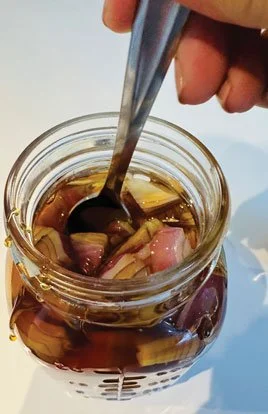
Honey & Onion Natural Cough Syrup
For uncontrollable coughs, I got this recipe from a client and a friend, who is from Bogoria, and she used this recipe for her husband when he could not stop coughing, and no store-bought medication was working. Now I use it for my kids during the cold season.
Preparation time: Less than 5 minutes
Infusion Time: 3-12 hours
Ingredients:
1 medium-sized onion, chopped into cubes (red or yellow, though yellow onions are generally stronger)
Honey (equal amount of honey to the volume of onions)
Dosage:
Take a shot or a tablespoon before bedtime for cough relief.
Preparation:
Peel and chop the onion into cubes, placing them in a jar.
Pour honey into the top of the onion, ensuring it coats the onion thoroughly. Aim for nearly equal parts onion and honey.
Let the jar sit on the counter for up to three nights. During this period, turn the jar upside down and right side up in between the three days. This helps ensure thorough mixing. Be cautious when placing the jar upside down, as gas may cause leakage. Limit the upside-down time to 30 minutes.
While you can consume the syrup after 3 hours, allowing it to mix for the full 3 days yields a stronger solution.
Straining and Storing:
After 3 days, strain or scoop out the onions.
Store the resulting syrup in the refrigerator for up to three months.
Note:
This home remedy is intended for adults only; do not administer to infants and young children.
This suggestion is not a substitute for medical advice. Consult with a doctor, and check for allergies before use.
While these properties make honey and onion a popular home remedy for coughs, it's essential to note that individual responses can vary, and scientific evidence supporting the efficacy of this specific combination is limited. It's always advisable to consult a healthcare professional, especially if the cough persists or if underlying health conditions are present. Additionally, this remedy is recommended for adults, and caution should be exercised in case of allergies or adverse reactions.
_____________________________________________________________________________________________________________________________________
Honey & Garlic Natural Antibiotic Syrup
Garlic is a powerful natural antibiotic that can help fight off the bacteria causing your cough and cold. Crush a few cloves of garlic and mix them with a teaspoon of honey. Consume this mixture daily to boost your immune system and alleviate symptoms.
Preparation time: Less than 5 minutes / Infusion Time: 3-12 hours
Ingredients:
1 medium-sized garlic clove, chopped
Honey (equal amount of honey to the volume of garlic)
Dosage:
Take a teaspoon for cough relief.
Preparation:
Peel and chop the garlic and place it in a jar.
Pour honey into the top of the garlic, ensuring it coats the onion thoroughly. Aim for nearly equal parts onion and honey.
Let the jar sit on the counter for up to three nights. During this period, turn the jar upside down and right side up in between the three days. This helps ensure thorough mixing. Be cautious when placing the jar upside down, as gas may cause leakage. Limit the upside-down time to 30 minutes.
While you can consume the syrup after 3 hours, allowing it to mix for the full 3 days yields a stronger solution.
Straining and Storing:
Store the resulting syrup in the refrigerator for up to three months.
Note:
This home remedy is intended for adults only; do not administer to infants and young children.
This suggestion is not a substitute for medical advice. Consult with a doctor, and check for allergies before use.
While these properties make honey and onion a popular home remedy for coughs, it's essential to note that individual responses can vary, and scientific evidence supporting the efficacy of this specific combination is limited. It's always advisable to consult with a healthcare professional, especially if the cough persists or if there are underlying health conditions. Additionally, this remedy is recommended for adults, and caution should be exercised in case of allergies or adverse reactions.
_____________________________________________________________________________________________________________________________________
Honey & Lemon Tea
One of the most popular and time-tested remedies for cough and cold is a soothing mixture of honey and lemon. Honey has natural antibacterial properties and can help soothe a sore throat, while lemon provides a boost of vitamin C. Simply mix a tablespoon of honey with freshly squeezed lemon juice in warm water and drink it several times a day.
_____________________________________________________________________________________________________________________________________
Ginger Tea
Ginger has powerful anti-inflammatory properties and can help relieve congestion caused by a cold. Prepare a cup of ginger tea by boiling fresh ginger slices in water for 10 minutes. Add a little honey and lemon juice for added flavor and enjoy the warm, soothing beverage.
By incorporating these natural remedies into your routine, you can find relief from cough and cold symptoms while boosting your immune system. Remember to stay hydrated, get plenty of rest, and listen to your body's needs. Here's to a healthier, happier you!
Meridians are the body’s energetic pathways. They help circulate life force (Qi), support organ function, and connect the physical and emotional layers of your system. There are two main types: the Extraordinary Meridians (The 8 Deep Vessels) are imbalanced → deeper constitutional or emotional patterns emerge, and the Main Meridians (The 12 Primary Channels) are imbalanced → symptoms appear quickly.
What are Meridians?
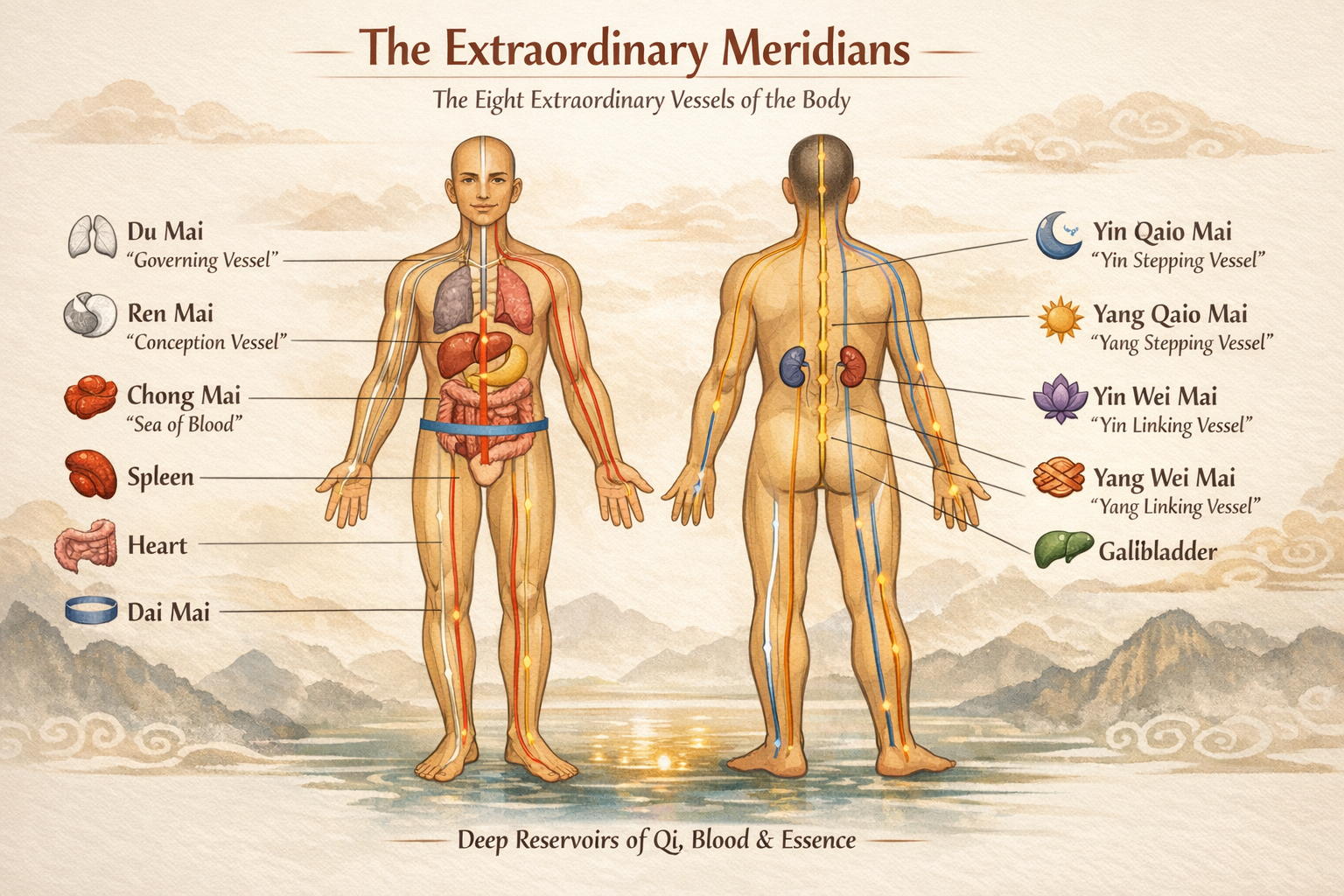
Extraordinary Meridian (The 8 Deep Vessels)
What are the Extraordinary Meridians?
Conception Meridian / Ren Mai
(North to South / Flows from the perineum, runs up along the center of the abdomen and chest, through the cheek, and enters the eye sockets.)Responsible for: Storage of Yin energy / Balance of the Yin Meridians
Symptoms of Imbalance:
Reproductive system trouble (male and female) / Fetal health / Impotence / Issues with the face, lips, and eyes / Digestive trouble / Spleen trouble
Girdle Meridian / Dai Mai
(Left to Right / begins at the underside of the ribs, continuing down to encircle the waist horizontally, connecting all the leg meridians.)
Responsible for: Energy flow balance between the upper and lower body / Binds Yin and Yang / Qi and blood circulation in the legs / Supports lower back
Symptoms of Imbalance:
Discomfort or weakness in the lower back / Discomfort or heavy feeling in the body / Difficulty walking / Weakness or atrophy of the legs / Discomfort, coldness, tension, poor circulation in the legs / Abdominal fullness / Difficult urination / Cloudy urine / Excessive vaginal discharge / Hernias / Miscarriages
Governing Meridian: Du Mai(North to South / Crown to Tail Bone / Center / Back/ Similar to Conception Meridian)
Responsible for: Storage of Yang Energy / Balance of Yang Meridians / Circulation of blood and Qi in Yang Meridians
Symptoms of Imbalance:
Brain and nervous system issues / Bone marrow issues / Spinal cord issues / Stroke / Psychological issues / Headache
Penetrating Meridian: Chong Mai (North to South / Left Ear, mouth, Left Center, Left Root to Left Foot Pinkey / Front)
Responsible for: Regulates Qi and blood circulation inside the 12 Main Meridians / Influences and regulates menstruationSymptoms of Imbalance:
Female reproductive system issues / Nausea / Gastrointestinal issues / Circulatory system issues / Musculoskeletal issues (human locomotor system) / Spiritual issues / Depression / Anxiety
Yang Heel Meridian / Yang Qiao Mai: (North to South / Outside of the Heel, runs upward along the outside of the leg and torso, then runs back around the rear of the shoulder, up along the side of the neck, then the mouth, up to the eye, and around the inside of the skull)
Responsible for: Storage of Yang Energy / Balance of Yin and Yang / Ascent of fluids / Descent of energy / Balance of sleep
Symptoms of Imbalance:
Visual disorders / Insomnia / Trouble walking / Lower limb trouble / Epilepsy with seizures / State of resistance
Yang Linking Meridian: Yang Wei Mai (North to South / From the ankle and continues up the side of the body along with the Shaoyang Gall Bladder Meridian of the foot, further up to the shoulder, and up and over the forehead, where it communicates with the Governing Meridian.
Responsible for: Storage of Yang Energy / Balance of Yang Meridians
Symptoms of Imbalance:
Lack of energy / Chills / Fevers / Lower back discomfort
Yin Heel Meridian: Yin Qiao Mai (From the inner ankle, runs up along the inner leg, the abdomen, chest, and neck, entering the eye to communicate with the Yang Heel Meridian.)
Responsible for: Storage of Yin Energy / Balance of Yin and Yang / Ascent of fluids / Descent of energy / Balance of sleep
Symptoms of Imbalance:
Cold, weakness or numbness in the lower limbs / Lower back discomfort / Digestive issues / Urogenital problems / Respiratory issues / Excessive sleepiness / Visual disorders / Hot flashes / Lower abdominal discomfort
Yin Linking Meridian / Yin Wei Mai: (North to South / Center Under the Head to Center Legs / Left and Right / Front)
Responsible for: Storage of Yin Energy / Balance of Yin MeridiansSymptoms of Imbalance:
Blood circulation problems / Depression / Headaches / Chest or heart discomfort / Gastric discomfort / Loss of willpower
What they do
Store and regulate your core energy (Qi, Blood, and Essence)
Influence hormones, development, and long-term cycles
Support emotional processing and deeper healing
Connect and coordinate all other meridians
When they’re out of balance
You might notice:
Repeating emotional patterns
Feeling stuck or disconnected
Hormonal or reproductive shifts
Chronic fatigue or burnout
A sense of “this is deeper than stress.”
These meridians are often addressed when you’re working on deeper healing, old patterns, or long-term change.
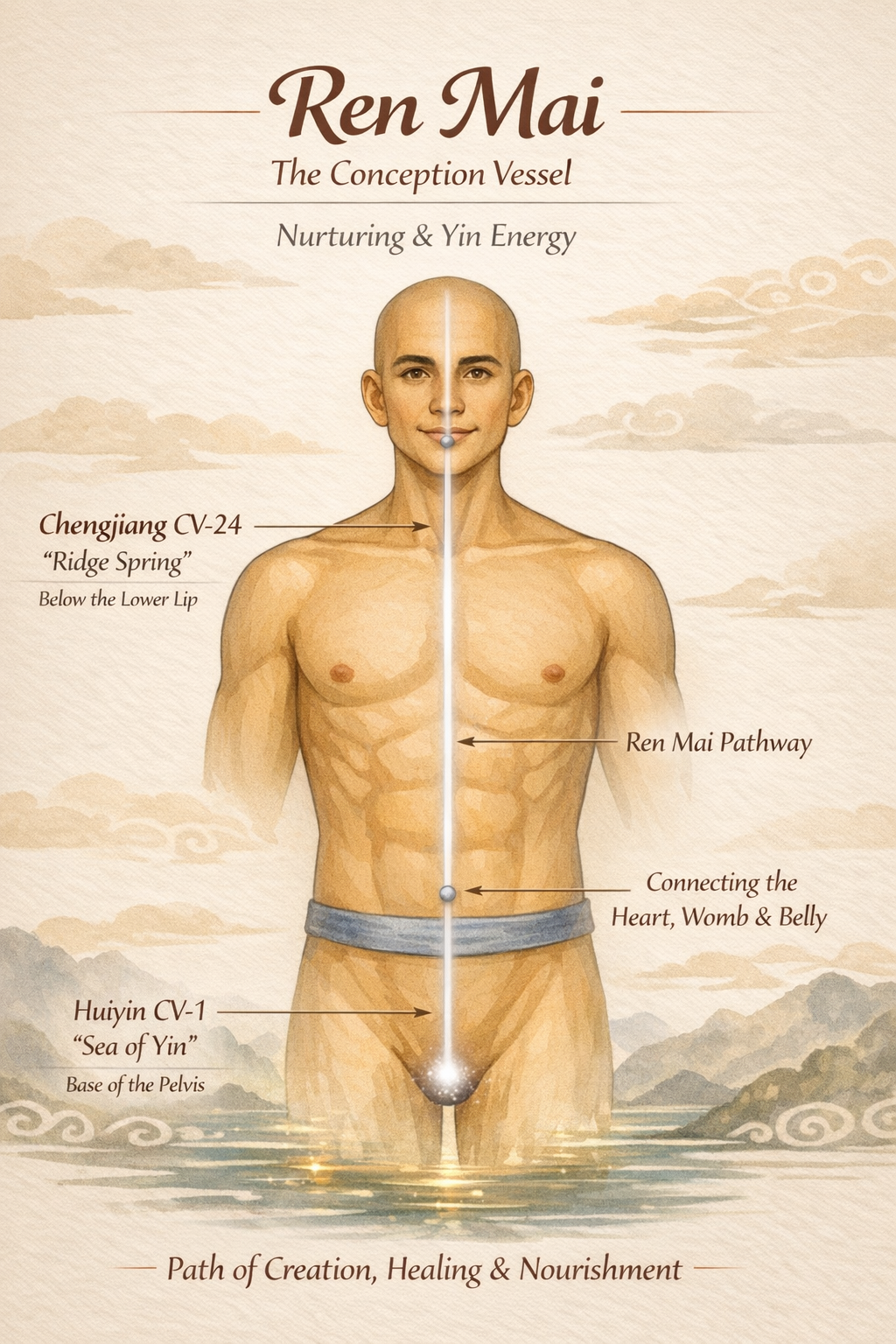
They act like the body’s deep oceans—storing, regulating, and redistributing Qi, Blood, and Jing (essence). They shape constitutional patterns, development, and long-term cycles.
What are Main Meridians (The 12 Primary Channels)
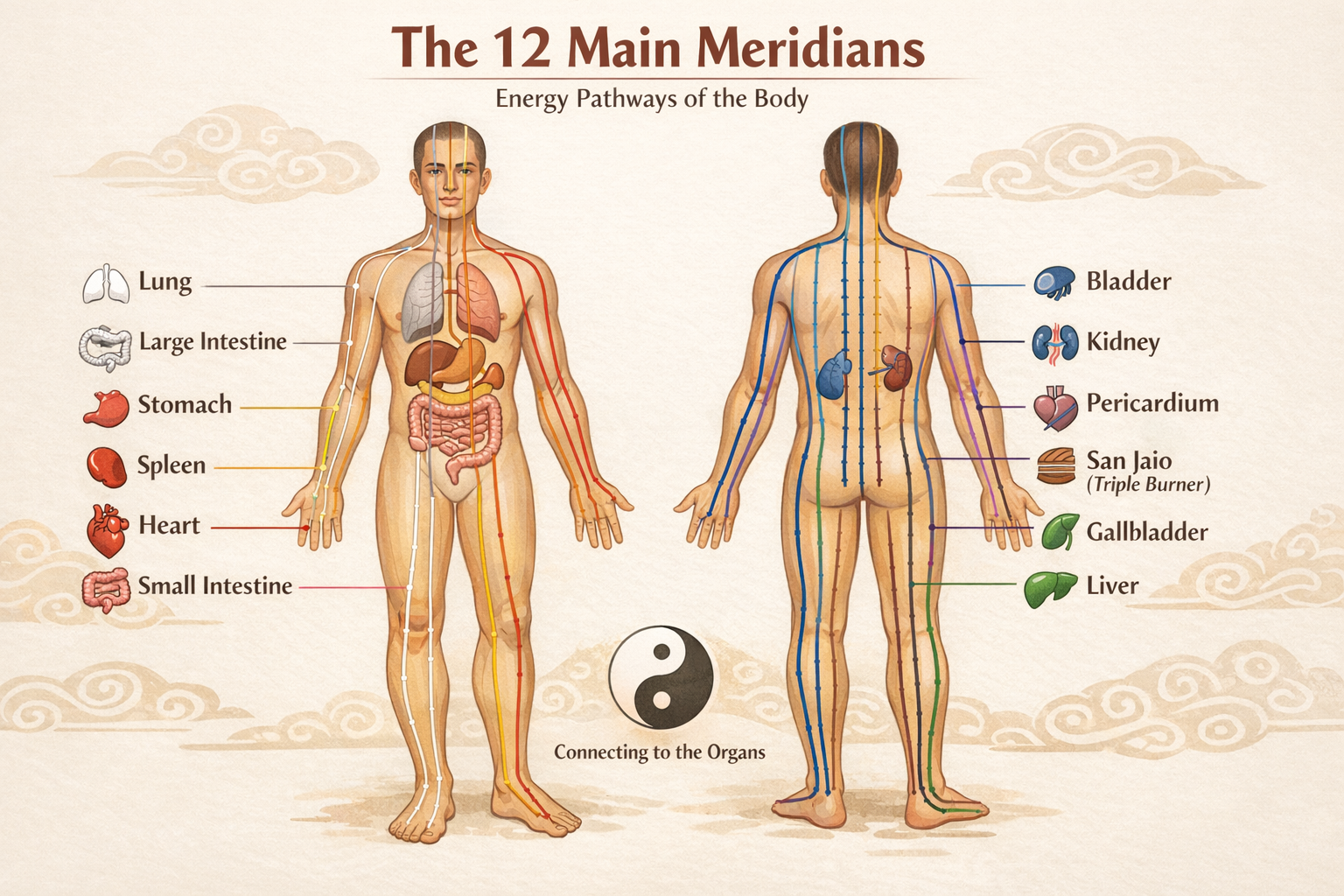
These are the body’s main rivers—the everyday channels that circulate Qi and Blood through the organs and tissues. The body’s daily energy pathways support your organs, immunity, digestion, sleep, mood, and overall balance. When the main meridians are imbalanced → symptoms appear quickly.
Think of these as the body’s daily energy pathways (main river). They support your organs, immunity, digestion, sleep, mood, and overall balance.
What are the Main Meridians?
Bladder Meridian: (North to South / The flow starts at the head, runs across the trunk, along the front, lateral, and back sides of the leg to the foot.)
Symptoms of Imbalance:
Physical problems in the organ, such as incontinence, trouble with urination
Excess negative emotional energy generated by the organ
Eye problems
Runny nose, nasal congestion
Nosebleeds
Discomfort in the head, neck, back, groin, and buttocks
Gallbladder Meridian: (North to South / The flow starts at the head, runs across the trunk, along the front, lateral, and back sides of the leg to the foot.)
Symptoms of Imbalance:
Slow digestion / Indigestion after eating fats / Craving greasy food / Bloating / Gallstones / Acute abdominal discomfort
Excess negative emotional energy generated by the organ (see Chart of Emotions)
Trouble making decisions
Feeling criticized
Discomfort on one side of the body or head
Jaundice
Heart Meridian: (Mid-North to Mid-South / the flow runs from the chest, along the front arm, and continues down to the hand.)
Symptoms of Imbalance:
Physical problems in the organ, such as: Palpitations / Dizziness / Weakness / Shortness of breath / Circulatory system problems
Excess negative emotional energy generated by the organ (see Chart of Emotions)
Fever
Frequent sweating, night sweats
Insomnia
Pale, cold, and tired
Restlessness
Kidney Meridian: (North to South / the flow runs from the foot, along the inner side of the leg, crossing the front of the chest and abdomen, and continuing up to the head.)
Symptoms of Imbalance:
Physical problems in the organ, such as: Urination trouble— incontinence, frequent, night-time waking / Edema / Thirst / Discomfort or weakness in the lower back, joints and knees
Fatigue, exhaustion, lack of vitality
Excess negative emotional energy generated by the organ (see Chart of Emotions)
Adrenal fatigue
Appetite and diet trouble
Feeling cold and weak
Memory trouble
Hair loss
Tinnitus or poor hearing
Dizziness
Impotence or frigidity
Male sexual dysfunction
Female lack of menstruation
Large Intestine Meridian: (Mid-West to Mid-East / the flow of runs from the hand, along the back of the arm, up to the head.)
Organ/Gland Connection: Kidneys
Symptoms of Imbalance:
Physical problems in the organ such as:
Dehydration / Constipation / Diarrhea / Inflammation, colitis, diverticulitis
Excess negative emotional energy generated by the organ (see Chart of Emotions)
Control issues
Acidic body PH
Swollen gums
Foul or bloody stools
Lack of energy
Holding onto emotions
Weight gain
Food allergies
Edema
Halitosis
Thinning hair
Liver Meridian: (North to South / the flow runs from the foot, along the inner side of the leg, crossing the front of the chest and abdomen, and continuing up to the head.)
Symptoms of Imbalance:
Physical problems in the organ such as: Trouble detoxing / Cravings for alcohol / Craving greasy food
Excess negative emotional energy generated by the organ (see Chart of Emotions)
Violent temper
Intense throbbing headaches
Fatigue
Female hormonal and menstrual issues
Dizziness
Dry or blurry eyes
Lung Meridian: (Mid-North to Mid-South / the flow runs from the chest, along the front arm and continues down to the hand.)
Symptoms of Imbalance:
Physical problems in the organ such as: Shortness of breath / Tiredness / Coughing / Asthma
Excess negative emotional energy generated by the organ (see Chart of Emotions)
Discomfort in occipital area of skull
Sore throat
Pericardeium Meridian: (Mid-West to Mid-East / the flow runs from the chest, along the front arm and continues down to the hand.)
Symptoms of Imbalance:
Circulatory problems
Chest and heart discomfort
Palpitations
Mania
Spasms of the elbow and arm
Negative relationship patterns
Overjoy (shocks the system)
Sadness
Phobias
Trouble with intimacy
Imbalance of sexual feelings or intimacy
Small Intestine Meridian: (Mid-North to Mid-South / the flow runs from the hand, along the back of the arm, up to the head.)
Symptoms of Imbalance:
Abdominal discomfort / Bloating / Gas / Gut inflammation / Bacterial imbalance / Intestinal permeability / Fungal and mold pathogens / Constipation / Diarrhea / Slow digestion
Excess negative emotional energy generated by the organ (see Chart of Emotions)
Eating low nutrient food
Restlessness
Moodiness and irritability
Trouble focusing and making decisions
Negativity
PMS
Food allergies
Spleen Meridian: (Mid-North to South / the flow runs from the foot, along the inner side of the leg, crossing the front of the chest and abdomen, and continuing up to the head.)
Symptoms of Imbalance:
Nutrient malabsorption or lack of utilization / Fatigue / Immune issues / Excess negative emotional energy generated by the organ / Diabetes / Weight issues / Imbalance in appetite— overeating, lack of appetite, lack of protein intake / Weakness / Dementia / Stress / Bloating / Edema / Bruising / Dizziness / Pale, weak, sluggish and cold / Excess Nutrient malabsorption or lack of utilization / Fatigue / Immune issues
Excess negative emotional energy generated by the organ (see Chart of Emotions)
Diabetes
Weight issues
Imbalance in appetite— overeating, lack of appetite, lack of protein intake
Weakness
Dementia
Stress
Bloating
Edema
Bruising
Dizziness
Pale, weak, sluggish and cold
Excess phlegm
Stomach Meridian: (North to South / the flow starts at the head, runs across the trunk, along the front, lateral and back sides of leg to the foot.)
Symptoms of Imbalance:
Hunger / Nausea / Vomiting / Acid reflux / Thirst
Excess negative emotional energy generated (see Chart of Emotions)
Throat issues
Nosebleeds
Discomfort in the chest
Discomfort in the knee
Toothaches
Triple Warmer Meridian: (West to East / the flow runs from the hand, along the back of the arm, up to the head.)
Symptoms of Imbalance:
Imbalance in the fight, flight or freeze response
Stagnance of body fluids
Lack of body part connection, wholeness
Headache and migraine
Hearing issues, Tinnitus
Facial and neck stiffness
Toothache
Sore throat
Elbow discomfort
Imbalance in body temperature
Trouble letting go of negativity
What they do
Move energy through the whole body
Support day‑to‑day physical and emotional functioning
Respond quickly to stress, tension, or imbalance
Help you feel grounded, clear, and regulated
When they’re out of balance
You might notice:
Pain or tension
Digestive changes
Fatigue
Irritability or emotional swings
Feeling “off” or ungrounded
These meridians are often addressed in sessions when you’re dealing with current symptoms or stress patterns.
The 12 Primary Meridians
Each corresponds to an organ system:
Lung, Large Intestine
Stomach, Spleen
Heart, Small Intestine
Bladder, Kidney
Pericardium, San Jiao
Gallbladder, Liver
Main Meridians (The 12 Primary Channels)
Personal Inspirations
Non-Fiction Books:
Body
The Natural Healing Handbook: Build The Ultimate Apothecary with Ancient Herbal Remedies to Ease Pain, Soothe Inflammation and Restore Total Wellness by Celia Hersey
Quantum Healing Unlocked: Step-by-Step Guide to Healing with Frequencies, Lasers, Lights, and Terahertz Technology by Dr. Nadya Lutz TND
Sound Medicine by Leah Garfield
When the Body Says No: Exploring the Stress-Disease Connection by Gabor Maté M.D. (2020)
Your Body Speaks Its Mind by Stanley Keleman
Grief
If Anything Happens, I Love You by Will McCormack
Minority Experience
Minor Feelings: An Asian American Reckoning by Cathy Park Hong
Sigh, Gone by Phuc Tran
Motivation
Action Begins Success from Tony Robbins on YouTube
Book of the Hopi, by Frank Waters (Amazon Link)
How to Talk to Anyone: 92 Little Tricks for Big Success in Relationships by Leil Lowndes
Outliers: The Story of Success by Malcolm Gladwell
Tao Te Ching by Lao Tzu (Amazon Link)
The Alchemist by Paulo Coelho
The Art of War by Sun Tzu
The 7 Habits of Highly Effective People by David Goggins
Parenting
Battle Hymn of the Tiger Mother by Amy Chua
IF in Life: How to Get Off Life’s Sideline and Becoming Your Best Self by Rashad Jennings (for teen boys)
Inside Out and Back Again Thanhha Lai (tween book)
Stories of South Asian Supergirls by Raj Kaur Khaira (for tween girls)
The Playbook: 52 Rules to Aim. Shoot, and Score in This Game of Life by Kwame Alexander (for teen boys)
Relationship
Men Are from Mars, Women Are from Venus by John Gray
The 5 Love Languages by Gary Chapman
The Rules by Sherrie Schneider
Self Growth
Can’t Hurt Me: Mastering Your Mind and Defy the Odds by David Goggins
You Can Heal Your Life by Louise L. Hay
Your Roots Don't Define You: A Motivational Guide to Self-Esteem and Personal Transformation by Chris Appleton
Way of the Peaceful Warrior by Dan Williman
Novels:
Life Overview
Animal Farm by George Orwell
A Tree Grows in Brooklyn by Betty Smith
Lord of the Flies William Golding
Of Mice and Men by John Steinbeck
The Great Expectations by Charles Dickens
The Scarlet Letter by Nathaniel Hawthorne
Uncle Tom’s Cabin by Harriet Beecher Stowe
Parenting
Because a Little Bug Went Ka-choo by Dr. Seuss
Booked by Kwame Alexander (for teen boys)
Ghost by Kwame Alexander (for teen boys)
Mr. Brown Can Moo! Can You? by Dr. Seuss
Oh! The Places You’ll Go by Dr. Seuss
Rebound by Kwame Alexander (for teen boys)
The Crossover by Kwame Alexander (for teen boys)
Self Discovery
Lady Chatterley's Lover by D.H. Lawrence
Pride and Prejudice by Jane Austen
The Crossover by Kwame Alexander (for teen boys)
Rebound by Kwame Alexander (for teen boys)
Wuthering Heights by Emily Brontë
Undiscover Story/Author:
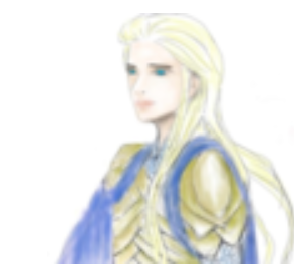
What it Means to Be a King by Arinariel is the best fandom writing I've ever read on J. R. R. Tolkien's The Lord of the Rings. The story beautifully unfolds the journey of young Thranduil as he discovers himself and matures into a king.
“What stands out to me is the author's meticulous adherence to J. R. R. Tolkien's rich and immersive world, making it a truly captivating read for fans of The Lord of the Rings." — Young
Animation (A) / Movies (M) / Series (S) / YouTube (Y):
Empath
7 Signs You Are A Heyoka Empath (VERY RARE!) by Minded (Y)
7 Signs You Are A Heyoka, The Most Powerful Empath by Empaths Refuge (Y)
HEYOKA EMPATH
1) Discernment occupies them, contrary to the norm, and you feel the emotions of others. Mood detector
2) Always interrupt people because it is innate, and they will forget if not brought out now
3) Sleep solves problems or gives answers to problems
4) Preoccupied with the fantasy virtues of magic
5) Often a muse to others with healthy inspiration
6) Goes the opposite or unusual direction, orientation, thinking is different, and argumentative
— @Marysiewert (Made a simplified list from this YouTube video in the comments section)
12 Signs You Are A Heyoka, The Most Powerful Empath by Butterfly Wing (Y)
1. Path less travelled
2. The intuitive paradox (knowing)
3. The wisdom interupter
4. The creative contradiction, finding order in chaos
5. The ageless soul, Childlike wonder with ancient wisdom
6. The living mirror reflecting what others can’t see
7. The compassionate truth teller, healing through honesty
8. The dreaming healer, solving while sleeping
9. The magical realist, living between worlds
10. The chaos server, finding peace in uncertainty
11. The sacred clown, healing through laughter
12. The wounded healer, turning pain into purpose
— @Janice-g7z (Made a simplified list from this YouTube video in the comments section)
The Empath Is Just the Child Who Was Never Allowed to Be Selfish by noema (Y)
Grief/Loss
It’s Okay to Not Be Okay (S)
Julie and the Phantoms (S)
Joy Luck Club (M)
Mystic Pop-up Bar (S)
Silver Linings Playbook (M)
Up (AM)
Life Overview
Click (M)
Forrest Gump (M)
Groundhog Day (M)
The Bucket List (M)
Narcissist
Why the Narcissist Never Recovers After Betraying a Deep Empath by noema (Y)
The narcissist is living a tragedy of their own making. They survived a dysfunctional childhood by adopting coping mechanisms. I can't fault them for that. The tragedy is that they didn't/couldn't put those coping mechanisms aside once they grew up/escaped the toxic abusers. Not that it's easy: getting oneself re-parented is a difficult, painful, lifelong process. And even with hard work, there's no guarantee of success. The tragedy is that they don't try. (Oh, sometimes they try a little bit, like dipping their toes in, and quickly retreat when they experience discomfort.) And so they condemn themselves to a frozen, stagnant existence, in pain and denial, for their entire lives. And they inflict pain on the deeply empathic person who committed the unpardonable sin [!] of actually loving them. That must be punished! And they punish us plenty. Until we walk away, to save our own lives, quietly and forever.
— @apricotcookie4850 (YouTube comment for this video. The best comment ever)
Self Discovery
Bend It Like Beckham (2002)
Hitch (2005)
Muriel’s Wedding (1994)
The First Wife Club (1996)
The Secret Garden (1993)
Thought Vibration
The Secret (2006)
Up in the Air (2009)
Yes Man! (2009)
People to Learn about:
Chris Langan
(Bouncer) Highest IQ Score, but did not know how to apply practical intelligenceFreida Kahlo
(Painter): Overcoming limitationsGabor Maté M.D
Physician and author, worked in family practices and specializes in childhood development and trauma, including long-term effects on physical and mental health, such as autoimmune diseases, cancer, Attention Deficit Hyperactivity Disorder (ADHD), and addiction.John Naber
(Olympic Medalist): Setting small goals to make a big impactLao Tzu (Also known as Lǎozǐ / Lao-tsze)
The legendary Chinese philosopher, considered to be the author of the Tao Te Ching, is one of the foundational texts of Taoism.Michael Jordan
(Basketball Player): Encouragement & persistenceTony Robbins
(Author): Coming from nothing to overcoming his optical
Quotes to Remember:
“Becoming a girl to a woman isn't just about age; it's about standing strong on your own, without relying on your mom's help." – Young Battista
“Don't cry because it's over, smile because it happened.” – Dr. Seuss
“Don’t let the past steal your present.” – Cherralea Morgen
“Don’t put off living to next week, next month, next year, or next decade. The only time you’re ever living is in this moment.” – Celestine Chua
“Expect the best, Prepare for the worst.” – Muhammad Ali Jinnah
“Everybody is a genius. But if you judge a fish by its ability to climb a tree, it will live its whole life believing that it is stupid.” – Albert Einstein
“Everything around us is made up of energy. To attract positive things in your life, start by giving off positive energy.” – Celestine Chua
“I don’t decide who I can help, only the receiver of the help can decide that for themselves.” – Young Battista
“It’s not the years in your life that count. It’s the life in your years.” – Abraham Lincoln
“Life is in three stages. The first stage is you learn, the second stage is you earn, and the third stage is you return?” – Carmine Battista
“Take care of your body. It’s the only place you have to live.” – Jim Rohn
“The consequences of today are determined by the actions of the past. To change your future, alter your decisions today.” – Unknown
“The mystery of life is not a problem to be solved but a reality to be experienced.” – Art Van Der Leeuw
“The rocks on the path may hinder one’s passage, but they also add to the beauty of the place and the wisdom of the traveler.” - Varda Quenya, from the story What it Means to Be a King by Arinariel
“What lies behind us and what lies before us are tiny matters compared to what lies within us.” – Ralph Waldo Emerson
“When one door closes, another opens, but we often look so long and so regretfully upon the closed door that we do not see the one which has opened for us.” – Alexander Graham Bell
“When you don’t get what you want, you suffer. If you get it, you suffer too since you can’t hold on to it forever.” – Peaceful Warrior, on the fallacy of attachment
“Who rules? The majority rules. But who changes the world? Hero, and it only takes one person to be a hero.” – Young Battista
Nervous System Basics
Sleep Aid Naturally
Sleep is one of the body’s oldest healing instincts—an inner tide that knows how to restore, repair, and soften us back into balance. Yet in a world of constant stimulation, many of us forget how to follow that tide. Natural sleep remedies invite us to reconnect with the body’s own rhythms through gentle, supportive practices: calming herbs, breathwork, sensory rituals, and small shifts that signal safety to the nervous system. This resource list offers simple, nourishing ways to help the body unwind so rest can arrive more easily, naturally, and without force.
Food for Sleep:
5 Foods That Improve Sleep Quality Dr. Eric Berg DC
Foot Movements:
Sleep Meditations:
Guided Meditation for Sleep Relaxation Series: Let Go Of Worries & Strengthen Health (not the Hypnosis) by Michael Sealey on YouTube
Sleep Talk Down Guided Meditation Series (not the hypnosis) by Jason Stephenson on YouTube
Release Negative Thoughts: Spoken Affirmations for Peaceful, Calm, Positive Mind by Jason Stephenson on YouTube
Sleep Yoga:
Wind Down Yoga – 12-minute Bedtime Yoga by Yoga with Adriene on YouTube
Yoga for Bedtime – 20-minute Practice by Yoga with Adriene on YouTube
Somatic Memory
You may experience persistent fatigue, ongoing discomfort, or a noticeable decline in your usual energy levels. These kinds of symptoms can sometimes be connected to somatic memory—the body’s way of storing past experiences through physical sensations rather than conscious thought.
Somatic memory shows up in tension, reflexes, posture, and emotional reactions that happen automatically. These patterns often develop from stress, learned behaviors, or earlier experiences that shaped how the body protects itself.
This emotion resource list offers clear, practical tools to help you understand these body‑based patterns. Whether you’re exploring stress, trauma, creativity, or family influences, these resources support a gradual process of noticing what the body has been holding and helping it move toward greater balance and ease.
Abandonment: Abandonment often arises when the body senses disconnection, loss of support, or a sudden absence of emotional safety.
Somatic cues: hollow feeling in the chest, sinking in the stomach, throat tightening, shoulders curling inward, numbness, or emotional distance.
Abandonment can make the body feel like it’s collapsing inward or withdrawing from connection, and gentle grounding or co‑regulation practices may help the system feel more supported and less alone.
Anger: Anger is a natural, mobilizing emotion — it brings heat, energy, and the impulse to protect.
boundaries crossed, needs unmet, energy turned inward, a lifetime of holding too much, a body that has been in protection mode for too long
Somatic cues: jaw tension, clenched fists, tight chest, faster breathing.
When anger is held in or chronically suppressed, it can create long-term tension in the body and emotional strain. Supportive outlets and healthy expression can help release this stored energy.
Anxiety: Anxiety often arises when the body senses uncertainty or feels unprepared.
Somatic cues: buzzing under the skin, restlessness, shallow breath, difficulty relaxing.
Anxiety can make the body feel like it’s stuck in “flight” or “freeze,” and grounding practices may help bring the system back toward safety.
Betrayal: Betrayal often arises when the body senses a rupture in trust, safety, or loyalty — especially from someone who was expected to protect, support, or care.
Somatic cues: sharpness or heat in the chest, tightening in the jaw, a sinking or twisting in the stomach, shoulders bracing, sudden waves of anger or collapse.
Betrayal can make the body feel both activated and withdrawn at the same time, and gentle grounding, emotional naming, and slow reconnection practices may help the system process the shock and restore a sense of internal stability.
Bitterness: Bitterness often arises when the body holds onto unresolved hurt, disappointment, or a sense of being treated unfairly over time.
Somatic cues: tightness in the chest, tension in the jaw, a heavy or compressed feeling in the stomach, shoulders hardening, a lingering sense of emotional “stuckness.”
Bitterness can make the body feel closed, guarded, or rigid, and gentle emotional naming, softening practices, and slow release work may help the system loosen the grip of old pain and create space for movement again.
Blaming: Blaming often arises when the body feels overwhelmed, powerless, or hurt and looks for a place to direct that intensity.
Somatic cues: tightness in the jaw, heat rising in the chest, pointing or pushing energy in the arms, a forward‑leaning posture, tension around the eyes or forehead.
Blaming can make the body feel activated and outward‑focused, and slowing the breath, softening the shoulders, and naming the underlying emotion may help the system shift from reaction into clarity and self‑support.
Cancer: Cancer often arrives in a body that has been carrying immense emotional weight for many years.
swallowing their truth, carrying emotional burdens for others, living in chronic stress, not feeling permission to express anger or assert needs
Defensiveness: Defensiveness often arises when the body senses criticism, threat, or the possibility of being misunderstood or harmed.
Somatic cues: chest tightening, jaw clenching, shoulders lifting, heat rising in the face, a sudden urge to justify or explain, a bracing or pushing‑forward posture.
Defensiveness can make the body feel guarded and on alert, and slowing the breath, softening the shoulders, and pausing before responding may help the system shift from protection into clarity and connection.
Depression: Depression often arises when the body has been carrying too much for too long and begins to move into collapse, exhaustion, or emotional shutdown.
Somatic cues: heaviness in the limbs, slowed movements, low energy, a hollow or weighted feeling in the chest, difficulty initiating action, flat or muted emotional tone.
Depression can make the body feel slowed, dimmed, or pulled inward, and gentle structure, small movements, softening practices, and supportive connection may help the system find steadiness and begin to re‑engage with the world at a sustainable pace.
Despair: Despair often arises when the body feels overwhelmed by hopelessness, exhaustion, or the sense that nothing will change or improve.
Somatic cues: heaviness in the chest, a sinking or collapsing feeling in the belly, slowed or shallow breath, numbness, difficulty moving or initiating action, a sense of emotional or physical shutdown.
Despair can make the body feel like it’s giving up or folding inward, and gentle structure, small supportive actions, co‑regulation, and softening practices may help the system find even a small thread of steadiness or possibility again.
Disgust: Disgust often arises when the body senses something as unsafe, contaminated, or deeply misaligned with one’s values or boundaries.
Somatic cues: tightening in the stomach, a pulling‑back sensation in the chest, facial tension (especially around the nose and mouth), a sudden urge to withdraw, nausea or queasiness, heat or sharpness in the throat.
Disgust can make the body feel repelled or protective, and grounding, orienting, and gentle boundary‑support practices may help the system regain clarity and settle after the initial reaction.
Discouragement: Discouragement often arises when the body feels depleted after repeated effort, setbacks, or unmet expectations.
Somatic cues: heaviness in the chest, a slight collapse in posture, slowed breath, low energy, a sinking feeling in the stomach, difficulty initiating action.
Discouragement can make the body feel like it’s losing momentum or confidence, and gentle structure, small achievable steps, and supportive connection may help the system regain steadiness and a sense of forward movement.
Failure: Failure often arises when the body feels it has fallen short, disappointed others, or lost something important.
Somatic cues: heaviness in the chest, a sinking feeling in the stomach, lowered posture, slowed breath, tension in the throat, difficulty initiating action.
Failure can make the body feel small, collapsed, or hesitant, and gentle self‑support, small achievable steps, and reconnecting with internal strengths may help the system regain steadiness and a sense of possibility.
Fear: Fear often arises when the body senses danger, unpredictability, or the possibility of harm — whether physical, emotional, or relational.
Somatic cues: tightness in the chest, quickened breath, a sinking or gripping feeling in the stomach, widened eyes, cold hands or feet, an urge to flee or freeze.
Fear can make the body feel hyper‑alert or immobilized, and grounding, orienting, and slow breath practices may help the system shift toward safety and steadiness.
Frustration: Frustration often arises when the body feels blocked, interrupted, or unable to move toward something important.
Somatic cues: heat rising in the chest or face, tension in the jaw, tight shoulders, a restless or agitated energy in the limbs, shallow or forceful breath.
Frustration can make the body feel pressured, stuck, or ready to burst, and slowing the breath, softening the shoulders, and pausing to reset may help the system shift from agitation into clarity and forward movement.
Grief: Grief often arises when the body is holding the weight of loss, change, or the absence of someone or something deeply meaningful.
Somatic cues: heaviness in the chest, a hollow or aching feeling in the belly, slowed breath, tightness in the throat, waves of emotion moving through the torso, fatigue or collapse in posture.
Grief can make the body feel tender, heavy, or overwhelmed, and gentle grounding, emotional naming, softening practices, and supportive connection may help the system move through the waves with steadiness and care.
Guilt: Guilt often arises when the body feels responsible for causing harm, falling short, or not meeting an internal or external expectation.
Somatic cues: heaviness in the chest, tightening in the throat, a sinking feeling in the stomach, lowered posture, tension in the jaw, a pull toward rumination or self‑correction.
Guilt can make the body feel burdened, contracted, or overly self‑focused, and gentle self‑reflection, emotional naming, and supportive connection may help the system move from self‑blame toward clarity and repair.
Hatred: Hatred often arises when the body carries intense hurt, fear, or betrayal that has hardened over time into protective anger. It can emerge when boundaries have been violated, trust has been broken, or pain feels too overwhelming to hold directly.
Somatic cues: heat or burning in the chest or stomach, tension in the jaw, clenched fists, a rigid or braced posture, rapid or forceful breath, a strong forward‑pushing energy, narrowed focus or gaze.
Hatred can make the body feel charged, defensive, or consumed, and grounding, emotional naming, softening practices, and exploring the underlying hurt or fear may help the system shift from reactive intensity toward clarity, safety, and repair.
Heartache: Heartache often arises when the body is holding emotional pain, longing, or the ache of unmet needs, broken connection, or deep disappointment.
Somatic cues: pressure or aching in the chest, tightness in the throat, a sinking or hollow feeling in the stomach, waves of heaviness, slowed breath, a pull toward stillness or quiet.
Heartache can make the body feel tender, fragile, or weighed down, and gentle grounding, softening practices, emotional naming, and supportive connection may help the system move through the ache with steadiness and care.
Horror: Horror often arises when the body encounters something shocking, grotesque, or profoundly disturbing — an experience that overwhelms the senses and violates one’s expectations of safety or reality.
Somatic cues: sudden freezing or immobility, wide or fixed eyes, coldness in the limbs, a sharp jolt in the chest or stomach, rapid or halted breath, trembling, a sense of disorientation or disbelief, an urge to recoil or pull away.
Horror can make the body feel destabilized, stunned, or deeply unsettled, and grounding, orienting to the present moment, slow breath work, and gentle co‑regulation may help the system move from shock toward steadiness and integration.
Jealousy: Jealousy often arises when the body senses a threat to connection, belonging, or something deeply valued.
Somatic cues: tightening in the chest, heat in the face or stomach, tension in the jaw, restless or agitated energy, a pulling‑forward or protective posture.
Jealousy can make the body feel reactive, insecure, or on alert, and grounding, emotional naming, and gentle boundary‑support practices may help the system shift from comparison or fear into clarity and steadiness.
Lack of Control: Lack of control often arises when the body feels overwhelmed by unpredictability, rapid change, or situations where agency feels limited or lost.
Somatic cues: tightness in the chest, gripping in the stomach, shallow breath, tension in the shoulders, restlessness in the limbs, a sense of internal scrambling or urgency.
Lack of control can make the body feel destabilized or on edge, and grounding, orienting, slow breath work, and gentle structure may help the system regain steadiness and reconnect with a sense of internal agency.
Love Unreceived: Love unreceived often arises when the body reaches toward connection, affirmation, or care and does not meet what it hoped for or needed.
Somatic cues: aching or pressure in the chest, tightness in the throat, a hollow or sinking feeling in the stomach, heaviness in the limbs, slowed breath, a pull toward withdrawal or quiet.
Love unreceived can make the body feel tender, disappointed, or quietly hurting, and gentle grounding, emotional naming, softening practices, and supportive connection may help the system hold the ache with steadiness and begin to reconnect with internal sources of worth and warmth.
Low Self-Esteem: Low self‑esteem often arises when the body carries old messages of inadequacy, comparison, or unworthiness, especially after repeated criticism, unmet needs, or experiences that diminished one’s sense of value.
Somatic cues: heaviness in the chest, a collapsed or inward‑folding posture, tightness in the throat, a sinking feeling in the stomach, lowered gaze, difficulty taking up space, or speaking up.
Low self‑esteem can make the body feel small, hesitant, or muted, and gentle grounding, self‑affirming practices, supportive connection, and slow rebuilding of internal trust may help the system reconnect with a steadier sense of worth and capability.
Lust: Lust often arises when the body feels a strong pull toward desire, connection, or physical closeness — an energized state where attraction, curiosity, and longing converge.
Somatic cues: warmth or heat in the chest, pelvis, or face; quickened breath; heightened sensation; focused attention; a forward‑leaning or reaching posture; increased energy or restlessness in the limbs.
Lust can make the body feel activated, alive, or intensely drawn toward another, and grounding, emotional naming, breath regulation, and attunement to boundaries may help the system hold this energy with clarity, safety, and choice.
Nervousness: Nervousness often arises when the body anticipates uncertainty, evaluation, or the possibility of making a mistake.
Somatic cues: fluttering or buzzing in the stomach, quickened breath, fidgeting
Here is Nervousness written in the same clean, somatic‑focused style as all your other entries — concise, grounded, and ready for your resource page.
Overwhelm: Overwhelm often arises when the body is carrying too many demands, emotions, or stimuli at once, leaving the system unable to organize or prioritize what needs attention.
Somatic cues: tightness in the chest, buzzing or pressure in the head, shallow breath, restlessness in the limbs, a sense of internal flooding, difficulty focusing, sudden fatigue or collapse in posture.
Overwhelm can make the body feel overloaded, scattered, or frozen, and grounding, slowing the breath, reducing input, and returning to one small, manageable step may help the system regain clarity and steadiness.
Panic: Panic often arises when the body perceives immediate danger or becomes overwhelmed by intense emotion, causing the nervous system to surge into a highly alert.
Somatic cues: rapid or shallow breath, racing heart, tightness in the chest, trembling or shaking, dizziness, a sense of losing control, tunnel vision, an urgent need to escape.
Panic can make the body feel flooded, destabilized, or disconnected, and grounding, slow breath work, orienting to the environment, and gentle co‑regulation may help the system shift from crisis activation toward safety and steadiness.
Resentment: Resentment often arises when the body holds onto repeated hurt, unmet expectations, or a sense of being treated unfairly without resolution.
Somatic cues: tightness in the chest, heat in the face or stomach, tension in the jaw, a protective or closed‑off posture, shallow breath, a lingering heaviness or pressure behind the sternum.
Resentment can make the body feel guarded, simmering, or stuck, and grounding, emotional naming, boundary‑support practices, and gentle release work may help the system shift from stored irritation toward clarity and repair.
Rejection: Rejection often arises when the body feels pushed away, unseen, or not chosen in moments where connection, belonging, or affirmation were hoped for.
Somatic cues: aching or tightness in the chest, heaviness in the limbs, a hollow or sinking feeling in the stomach, tightness in the throat, lowered posture, a pull toward withdrawal or self‑protection.
Rejection can make the body feel tender, exposed, or diminished, and grounding, emotional naming, softening practices, and reconnecting with supportive relationships may help the system move from hurt toward steadiness and self‑worth.
Sadness: Sadness often arises when the body is holding loss, disappointment, or unmet needs — moments where something hoped for, expected, or cherished feels out of reach.
Somatic cues: heaviness in the chest, a hollow or sinking feeling in the stomach, slowed breath, softened or collapsed posture, tightness in the throat, a pull toward quiet or stillness.
Sadness can make the body feel tender, heavy, or subdued, and grounding, emotional naming, gentle movement, and supportive connection may help the system move through the feeling with steadiness and care.
Self-Abuse: Self‑abuse often arises when the body is carrying intense shame, hopelessness, or emotional pain and turns that distress inward instead of toward support or connection.
Somatic cues: heaviness in the chest, tightness in the throat, a collapsed or withdrawn posture, a sinking feeling in the stomach, tension in the jaw, numbness or disconnection from the body, a pull toward isolation or self‑criticism.
Self‑abuse can make the body feel small, overwhelmed, or shut down, and grounding, emotional naming, gentle self‑compassion practices, and reaching toward safe connection may help the system shift from self‑directed harm toward steadiness, care, and support.
Shame: Shame often arises when the body feels exposed, flawed, or unworthy in the eyes of others or in its own internal gaze.
Somatic cues: heat or flushing in the face, tightness in the chest or throat, a collapsing or folding‑in posture, heaviness in the stomach, lowered gaze, a pull toward hiding or withdrawal.
Shame can make the body feel small, isolated, or deeply contracted, and grounding, emotional naming, gentle self‑compassion, and reconnecting with safe, supportive relationships may help the system shift from self‑judgment toward steadiness and dignity.
Shock: Shock often arises when the body encounters something sudden, overwhelming, or incomprehensible — an event that exceeds its capacity to process in real time.
Somatic cues: freezing or stillness, wide or unfocused eyes, coldness in the limbs, numbness or disconnection from sensation, halted or shallow breath, a sense of disbelief, disorientation, or being “outside” oneself.
Shock can make the body feel stunned, suspended, or destabilized, and grounding, orienting to the present moment, slow breath work, and gentle co‑regulation may help the system move from overwhelm toward steadiness and integration.
Sorrow: Sorrow often arises when the body is holding deep emotional pain, lingering grief, or the quiet ache of something meaningful that has been lost or cannot be restored.
Somatic cues: heaviness in the chest, a deep ache or hollowness in the belly, slowed or weighted breath, a gentle collapse in posture, tightness in the throat, a pull toward stillness, silence, or inwardness.
Sorrow can make the body feel tender, subdued, or quietly burdened, and grounding, emotional naming, gentle movement, and compassionate connection may help the system hold the depth of the feeling with steadiness and care.
Stubbornness: Stubbornness often arises when the body feels protective of its position, boundaries, or identity — especially in moments where change, vulnerability, or uncertainty feels threatening.
Somatic cues: tension in the jaw, tightness in the chest, a braced or rigid posture, shallow breath, heat in the face or stomach, a sense of internal “holding firm” or pushing back.
Stubbornness can make the body feel guarded, immovable, or resistant, and grounding, softening practices, emotional naming, and gentle curiosity may help the system shift from defensiveness toward openness, flexibility, and clearer choice.
Terror: Terror often arises when the body perceives extreme danger or helplessness, overwhelming the nervous system and pushing it into a state of intense survival activation.
Somatic cues: freezing or immobility, racing or pounding heart, rapid or shallow breath, trembling, coldness in the limbs, wide or unfocused eyes, a sense of dissociation or detachment from the body, an urgent need to escape paired with an inability to move.
Terror can make the body feel overtaken, powerless, or disconnected, and grounding, orienting to the environment, slow breath work, and safe co‑regulation may help the system gradually shift from crisis activation toward steadiness and safety.
Unsupported: Unsupported often arises when the body feels like it is carrying too much alone, moments where help, presence, or understanding were needed but not available.
Somatic cues: heaviness in the chest, a sinking or hollow feeling in the stomach, tightness in the throat, drooping posture, fatigue, a pull toward isolation, or a sense of bracing against the world.
Unsupported can make the body feel lonely, burdened, or quietly overwhelmed, and grounding, emotional naming, reaching toward safe connection, and small acts of self‑support may help the system move from aloneness toward steadiness and care.
Unworthy: Unworthy often arises when the body carries old messages of inadequacy, rejection, or conditional love — moments where value, belonging, or acceptance felt withheld or uncertain.
Somatic cues: heaviness in the chest, a sinking or hollow feeling in the stomach, lowered gaze, tightness in the throat, a collapsed or inward‑folding posture, a pull toward withdrawal or self‑minimizing.
Unworthy can make the body feel small, muted, or undeserving, and grounding, emotional naming, gentle self‑affirmation, and reconnecting with safe, supportive relationships may help the system shift from self‑doubt toward dignity, worthiness, and steadiness.
Vulnerability: Vulnerability often arises when the body is open, exposed, or emotionally transparent — moments where honesty, tenderness, or uncertainty invite deeper connection but also risk.
Somatic cues: softening in the chest, openness or ache in the heart area, slight tremble in the limbs, warmth in the face, loosened or lowered defenses, a mix of expansion and caution in the breath, a posture that leans forward or gently folds inward.
Vulnerability can make the body feel tender, uncertain, or courageously open, and grounding, emotional naming, slow breath work, and supportive connection may help the system hold this openness with steadiness, dignity, and care.
Worthless: Worthless often arises when the body carries deep layers of shame, rejection, or chronic self‑criticism — moments where one’s value, impact, or place in the world feels erased or doubted.
Somatic cues: heaviness in the chest, a hollow or sinking feeling in the stomach, tightness in the throat, lowered gaze, a collapsed or inward‑folding posture, fatigue, numbness, or a pull toward withdrawal and silence.
Worthlessness can make the body feel small, muted, or disconnected from its own significance, and grounding, emotional naming, gentle self‑compassion, and reconnecting with supportive relationships may help the system shift from self‑erasure toward dignity, presence, and worth.
Body Region (Function, Emotion, Symbolism)
Back & Spine:
Butt & Rear:
Fascia HoppingEnergy:
10 Daily TaiChi Moves|Small Steps, Giant Health Gains!Iodine Benefits EXPOSED: 7 Reasons Your Energy Feels Drained
The Acupoint in Your Collarbone That Unlocks Your Whole Body |TCM
Feet:
Bunion Band Treatment | Treatment and Exercises for Bunion Pain Relief | MELT Method10 Minute Foot Treatment | Enhance Posture & Circulation on Your Feet | MELT Express
Heart & Chest:
Hand:
Gut & Core:
Pooch, Leaks & Bloat GONE. Just 5 Mins IN BED [3:14]Hands & Arms:
Neck:
02:45Benefit 1: Relieving Neck, Shoulder, and Arm Pain
The Neck Release Sequence: Relieve Neck Tension | MELT MethodLegs:
10 Min Leg StrengthOrgan:
The Complete Hand Reflex Zone Routine, 9 Moves, 5 Minutes Every Organ Covered | TCMThe Two Gates on Your Wrist That Guard Your Entire Body (Neiguan & Waiguan)
Stress
05:15 Benefit 3: Managing Stress and Emotional Congestion
Books & Readings (General Themes)
The Body Keeps the Score: Brain, Mind, and Body in the Healing of Trauma
by Bessel van der Kolk M.D.The Emotional Code: How to Release Your Trapped Emotions for Abundant Health, Love, and Happiness
by Dr. Bradley Nelson (2019)Limitless Expanded Edition: Upgrade Your Brain, Learn Anything Faster, and Unlock Your Exceptional Life
by Jim KwikWhen the Body Says No: Exploring the Stress-Disease Connection
by Gabor Maté M.D. (2020)
Audio & Guided Resources
Guided body scans for grounding and sensory awareness.
Nervous system regulation tracks (vagal toning, humming, breath pacing).
Somatic meditation practices focused on felt sense and micro‑sensations.
Therapeutic & Clinical Modalities
Somatic Experiencing (SE)
Working with activation, discharge, and completion cycles.Sensorimotor Psychotherapy
Tracking posture, gesture, and movement as memory pathways.EMDR (Body‑Based Components)
Bilateral stimulation supporting integration of implicit memory.IFS with Somatic Integration
Creative & Expressive Pathways
Somatic journaling prompts
Writing from sensation rather than story.Drawing or mapping the body
Visualizing where memories or emotions live.Movement improvisation
Letting the body express what words cannot.Voice & sound release
Using tone, humming, or vocalization to access stored patterns.
Client‑Friendly Tools
“Where do I feel this in my body?” check‑ins
Emotion–sensation mapping charts
Daily nervous system tracking sheets
Somatic boundary exercises
Grounding and orientation practices
Ancestral & Energetic Layers (Optional Section)
Inherited patterns & epigenetic memory
Cultural somatic imprints
Energetic residue from past experiences
Rituals for release, grounding, and reconnection
Wellness Resources
Bullet Journaling:
Bullet Journaling for Beginners / How to Make a Key by Sunshine Stickers on YouTube
Bullet Journaling Key / Basic Symbols to Include in a Bullet Journal Key by Petite Turquoise on YouTube
The Bullet Journaling by The Founder
Motivation:
How to be Happy Every Day: It Will Change the World a TEDxTalk by Jaqueline Way on YouTube
How To Figure Out What You Want In Life by Wayne Dyer Meditation on YouTube
Morning Motivation Series by Be Inspire on YouTube
Morning Motivation Series by Motiversity on YouTube
Morning Motivation Series by Law of Attraction Coaching on YouTube
Rewire Your Brain: 300 Affirmations for Positive Thinking by Zhanna Hamilton on Audible
Start Every Day Winning by Team Fearless on YouTube
Qigong:
Qigong: Mood Lifter (15 minutes) by Yogi on YouTube
Qigong: Flow For Brain Optimization (20 minutes) by Yogi on YouTube
Qigong: Daily Qigong Routine (15 minutes) by Yogi on YouTube
Qigong for Beginners (30 minutes)by Yogi on YouTube
Qigong Shaolin: 20-Minute Daily Morning Routine by Shi Heng Yi Online
Zodiacs from East to West
Eastern Zodiac Animals
-
1924 / 1936 / 1948 / 1960 / 1972 / 1984 / 1996 / 2008 / 2020
-
1925 / 1937 / 1949 / 1961 / 1973 / 1985 / 1997 / 2009 / 2021
-
1926 / 1938 / 1950 / 1962 / 1974 / 1986 / 1998 / 2010 / 2022
-
1927 / 1939 / 1951 / 1963 / 1975 / 1987 / 1999 / 2011 / 2023
-
1928 / 1940 / 1952 / 1964 / 1976 / 1988 / 2000 / 2012 / 2024
-
1929 / 1941 / 1953 / 1965 / 1977 / 1989 / 2001 / 2013 / 2025
-
1930 / 1942 / 1954 / 1966 / 1978 / 1990 / 2002 / 2014 / 2026
-
1931 / 1943 / 1955 / 1967 / 1979 / 1991 / 2003 / 2015 / 2027
-
1932 / 1944 / 1956 / 1968 / 1980 / 1992 / 2004 / 2016 / 2028
-
1933 / 1945 / 1957 / 1969 / 1981 / 1993 / 2005 / 2017 / 2029
-
1934 / 1946 / 1958 / 1982 / 1982 / 1994 / 2006 / 2018 / 2030
-
1934 / 1947 / 1959 / 1983 / 1983 / 1995 / 2007 / 2019 / 2031
Western Zodiac Signs
-
March 21 to April 20
-
April 21 to May 21
-
May 22 to June 21
-
June 22 to July 23
-
July 24 to August 23
-
August 24 to September 23
-
September 24 to October 23
-
October 24 to November 22
-
November 23 to December 21
-
December 22 to January 20
-
January 21 to February 19
-
February 20 to March 20